
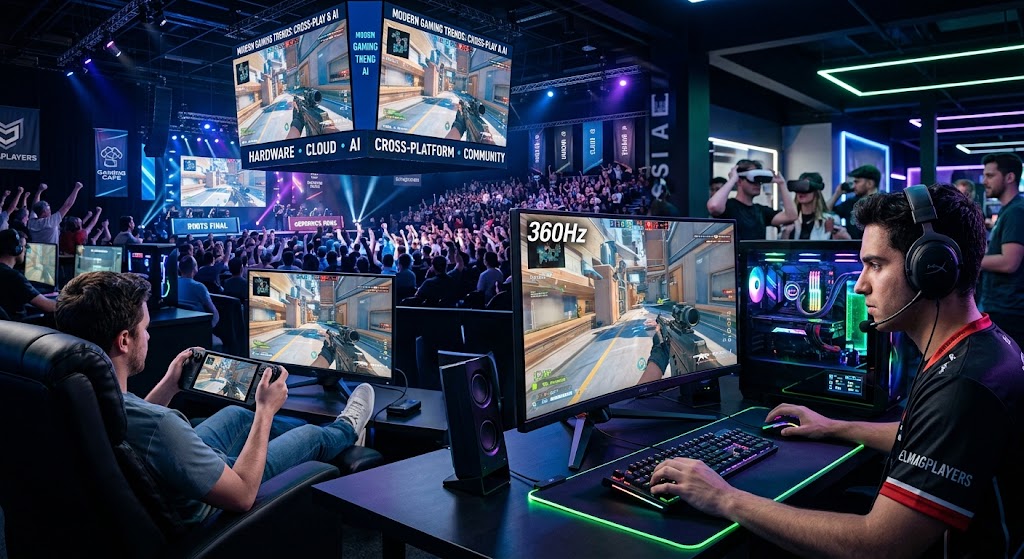
What Are the Latest Gaming Trends Elmagplayers Should Watch
Gaming moves faster today than ever before. If you step away from your setup for even a few months, the landscape feels completely different when you return.
Developers are pushing boundaries with fresh mechanics, smarter game worlds, and instant social connectivity. Meanwhile, player bases expect deeper interactivity and better performance on every device.
Understanding what are the latest gaming trends elmagplayers track helps you stay ahead of the curve, choose better titles, and upgrade your gaming setup at the right time.
From cloud rendering breakthroughs to community-driven economies, the industry is shifting rapidly. Let us look into the major movements defining interactive entertainment right now.
What Are the Latest Gaming Trends Elmagplayers Track in Hardware and Cloud Tech
Hardware expectations have changed dramatically over the last couple of seasons. Gamers no longer accept heavy thermal throttling or frame drops, even on modest hardware budgets.
Cloud platforms have matured from laggy experiments into daily drivers for millions. High-speed fiber and Wi-Fi 7 adoption made remote rendering practical for fast-paced competitive titles.
When looking at what are the latest gaming trends elmagplayers follow, hybrid handheld consoles sit right near the top. Dedicated portable systems handle modern AAA releases surprisingly well.
Here is a quick look at how gaming platforms and hardware preferences compare across active player groups:
| Platform Segment | Primary Hardware Focus | Key Advantage | Main Challenge |
|---|---|---|---|
| Desktop PC Systems | High-end GPUs & Custom Cooling | Maximum frame rates and visual fidelity | Higher initial investment cost |
| Hybrid Handhelds | Custom APUs & OLED Displays | Portability with full library access | Battery life constraints |
| Cloud Gaming Hubs | Low-latency Streaming Terminals | Zero local downloads or storage needs | Requires ultra-stable internet connection |
| Current-Gen Consoles | Standardized Custom Chips | Plug-and-play balance and exclusives | Limited component upgrade paths |
Component prices have stabilized, allowing players to build balanced mid-range rigs. Upgrades now focus heavily on display clarity, high refresh rates, and fast solid-state storage.
Storage demands keep growing rapidly. Games easily clear 100 gigabytes today, making fast NVMe drives essential for seamless asset streaming and short load times.
Display technology has shifted toward OLED panels with instant pixel response times. Clear motion during fast turns gives competitive players a noticeable edge.
So, why does hardware evolve so quickly? Because game engines demand more power to deliver realistic physics, complex lighting, and massive open worlds without stuttering.
Here are several key hardware features players prioritize when building or purchasing new rigs today:
- PCIe Gen 4 and Gen 5 NVMe drives for quick texture loading
- High refresh rate monitors operating at 144Hz, 240Hz, or higher
- DirectStorage API implementation to eliminate loading screens
- AI-assisted upscaling tools to boost frame output smoothly
- Custom liquid cooling setups to maintain stable clock speeds
These hardware upgrades allow studios to build complex gameplay environments. Players get smoother action, shorter loading sequences, and far better visual clarity overall.
Engineers are also focusing on thermal efficiency. Newer processors deliver impressive clock speeds while drawing significantly less power from the wall.
What Are the Latest Gaming Trends Elmagplayers Experience in Multiplayer Ecosystems
Multiplayer design has evolved far beyond basic matchmaking lobbies. Today, games act as living digital spaces where community interaction matters just as much as competitive play.
Cross-platform support is now mandatory for any serious online title. Players expect to team up with friends regardless of whether they play on PC, console, or mobile devices.
When analyzing what are the latest gaming trends elmagplayers discuss daily, dynamic online worlds stand out clearly. Live events and seasonal updates keep long-term titles fresh.
Publishers have realized that splitting player bases with paid map packs harms long-term engagement. Free updates paired with cosmetic items have become the standard industry model.
Here is how current game mechanics compare to traditional multiplayer design patterns:
| Game Feature | Traditional Multiplayer Style | Modern Live-Service Approach |
|---|---|---|
| Platform Access | Isolated servers per system | Seamless cross-play and cross-progression |
| Content Updates | Infrequent paid expansion packs | Frequent seasonal passes and free content drops |
| Matchmaking | Basic rank or ping filters | Skill-based, connection-optimized algorithms |
| Economy | Locked rewards tied to base game | Cosmetic shops and battle pass progression |
| World Design | Static static maps | Evolving environments with dynamic live events |
Anti-cheat technology has also become a massive talking point within competitive communities. Server-side validation and kernel-level drivers work constantly to keep matches fair for everyone.
Matchmaking algorithms strive to balance competitive intensity with short queue times. Players want matches that test their skills without feeling unfair or exhausting.
In-game social spaces allow players to show off rare accomplishments, hang out between matches, or participate in mini-games without jumping into intense combat loops.
Voice integration has improved significantly as well. Built-in noise suppression and spatial audio make tactical communication clearer during chaotic firefights or team raids.
Community feedback loops drive continuous balance patches. Developers tune weapon damage, character abilities, and map layouts based on direct player metrics and feedback.
Here are several key elements defining successful modern multiplayer experiences right now:
- Seamless cross-progression across multiple gaming platforms
- Sub-30 millisecond server tick rates for precise hit registration
- Modular cosmetic customization systems for characters and gear
- Integrated tournament platforms inside the game client
- Proactive proximity voice moderation and community guidelines
This relentless focus on connectivity ensures that competitive titles maintain strong populations for years after initial release, rather than fading away after a few months.
Developers are also building better spectator tools. Clean camera controls and real-time stats turn casual viewing into a popular entertainment option across streaming platforms.
Artificial Intelligence and Procedural World Generation
Artificial intelligence is changing how virtual environments are designed, rendered, and populated. Developers use machine learning models to accelerate asset production and level design.
Non-player characters are becoming far more adaptive. Instead of repeating simple scripted lines, NPCs analyze player actions, adjust combat tactics, and remember past interactions.
Procedural generation tools allow indie creators to build massive, detailed game spaces that previously required huge development teams. Random terrain, dynamic weather, and unique loot spawns make every playthrough feel distinct.
Ray tracing and real-time lighting calculations are also becoming faster thanks to dedicated AI cores on modern graphics cards. Light bounces off surfaces naturally, casting realistic shadows and reflections without destroying framerates.
So, what does this mean for everyday gameplay? It means bigger worlds, more responsive environments, and fewer long development cycles between franchise releases.
Audio systems use spatial audio modeling to replicate real-world sound propagation. You can accurately hear footsteps above you or pinpoint gunfire around corners inside dense urban maps.
Physics engines handle destructive environments smoothly today. Debris falls realistically, cover can be chewed away by heavy gunfire, and dynamic terrain deformation alters tactical options on the fly.
The Rise of User-Generated Content and Creator Economies
Players no longer want to just play games-they want to build within them. User-generated content platforms have grown into massive ecosystems housing millions of custom experiences.
Simple level editors have evolved into full-fledged development suites inside popular games. Creators can script custom game modes, design complex structures, and monetize their original work directly.
This shift keeps communities engaged indefinitely. When players finish official story campaigns, thousands of community-crafted maps and custom challenges wait for them.
Studios actively encourage this trend by providing robust modding toolkits and dedicated hosting servers. Successful community mods often spawn entirely new standalone gaming genres.
Here are several ways player-created content actively shapes modern gaming trends today:
- Custom arcade modes designed by players gaining standalone popularity
- Community-created cosmetic items sold through official creator programs
- Custom training maps designed specifically for practice and aim warmup
- User-built roleplay servers with unique economy scripts and rules
- Community translation packages opening games to wider global audiences
And this ecosystem benefits everyone involved. Developers extend the shelf life of their titles, creators generate real income, and players enjoy a steady stream of fresh gameplay ideas.
The boundary between developer and player continues to blur in healthy ways. Game development is becoming decentralized, democratic, and deeply community-driven.
Indie Innovation and Genre Blending
While massive AAA studios focus on blockbusters, independent developers continue to drive creative innovation across the industry. Indie teams take bold risks that larger companies often avoid.
Genre blending is especially popular right now. We see deck-building mechanics added to tactical roguelikes, cozy farming simulators turned into horror games, and survival games mixed with rhythm controls.
These surprising combinations keep gameplay loops fresh and memorable. Successful indie titles regularly top sales charts purely through word-of-mouth excitement and streamer coverage.
Early access models let developers build games alongside their player base. Constant feedback during early testing phases ensures the final product aligns directly with community expectations.
Publishers now pay close attention to the indie scene for fresh design inspiration. Many mechanics that start as experimental indie features eventually become standard inclusions in mainstream titles.
Compact, focused games respecting a player’s time have become extremely popular. Short, high-quality experiences offer refreshing alternatives to 100-hour open-world titles filled with tedious fetch quests.
Frequently Asked Questions
What Are the Latest Gaming Trends Elmagplayers Focus On
Players are focusing heavily on cross-platform accessibility, high refresh rate displays, and hybrid handheld devices. Cloud streaming and seamless online integration are also top priorities across major gaming communities.
Why Is Cross Play So Important in Modern Gaming
Cross-play allows players on different hardware platforms to play together without restrictions. It unites player bases, shortens matchmaking queue times, and extends the active lifespan of multiplayer games significantly.
How Are Handheld Consoles Changing PC Gaming
Portable gaming devices allow players to access their PC game libraries anywhere. Optimized hardware, custom operating systems, and fast sleep-resume functions make AAA gaming convenient for busy daily schedules.
What Role Does AI Play in Modern Game Development
Artificial intelligence assists with upscaling graphics, optimizing game code, procedural world creation, and dynamic NPC behavior. It speeds up production cycles and creates more responsive, lifelike virtual environments for players.
Are Cloud Gaming Platforms Ready for Competitive Play
Cloud platforms have improved dramatically due to lower network latency and high-speed fiber internet. While elite esports competitors still prefer local hardware, cloud streaming works exceptionally well for casual and narrative titles.
How Does User Generated Content Benefit Players
User-generated content provides an endless supply of custom maps, original game modes, and unique cosmetic items. It lets creative players monetize their skills while giving the rest of the community continuous fresh content for free.
Why Are Early Access Games So Popular Today
Early access allows players to participate directly in the development process by giving feedback, testing mechanics, and reporting bugs. Developers receive funding and practical user data, leading to a much stronger final release.
Keeping up with industry shifts makes gaming more enjoyable and rewarding. Whether upgrading your primary PC rig, exploring user-created game modes, or enjoying portable AAA titles on a handheld device, modern gaming offers unprecedented freedom. Track hardware advancements, stay connected with active communities, and enjoy the incredible evolution of interactive digital entertainment.




Leave a Reply