
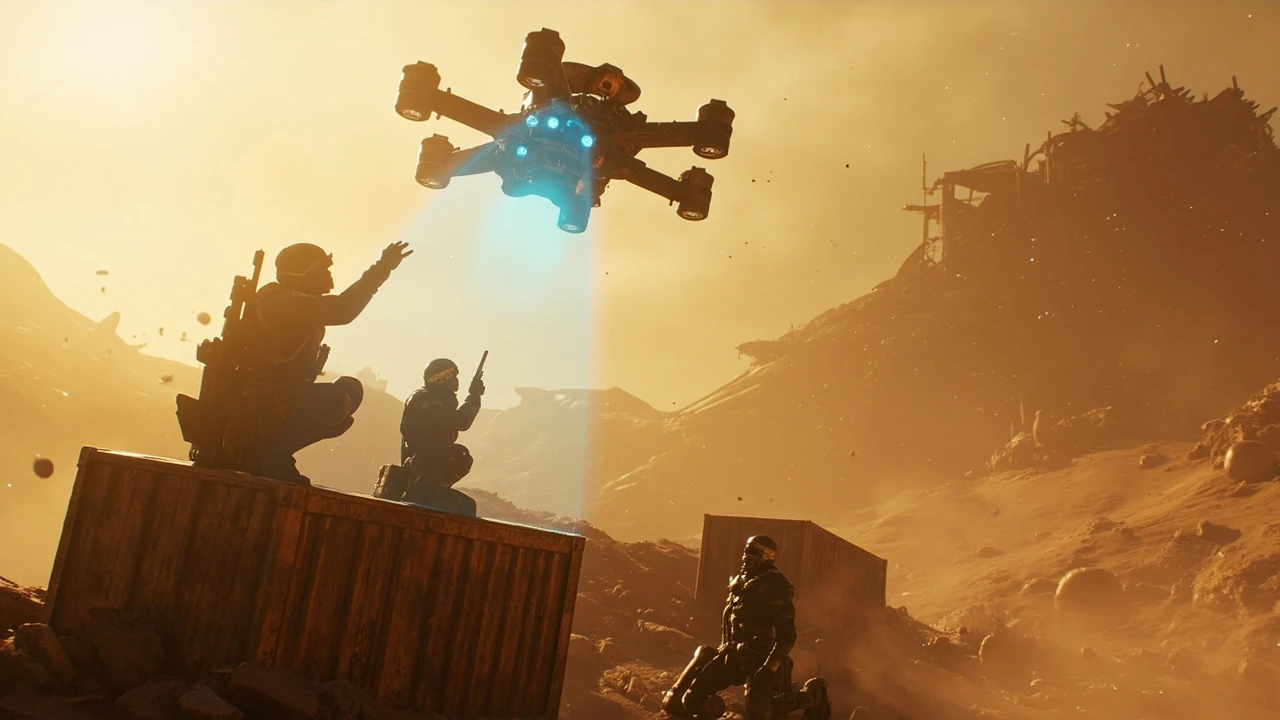
Eyes in the sky arc raiders: what the phrase covers and how to use it
Arc Raiders is a multiplayer extraction shooter built around a single recurring problem: you rarely know what is above you, around you, or about to drop on you. The phrase eyes in the sky arc raiders usually points to a player-facing concept tied to airborne reconnaissance, map-wide visibility, and the constant pressure of being watched while you loot. Understanding how that concept is framed in the game helps players plan safer routes and gives developers working on similar extraction loops a concrete reference for overhead awareness.
This article treats the eyes in the sky arc raiders idea as it has appeared in community discussion, in-game references, and the design language of Arc Raiders. It works as both a player guide and a small design study, because the question players ask about the mechanic and the question a developer asks when reading patch notes overlap more than they first appear. The aim is a working definition, a clear account of how information reaches players, and a list of practical trade-offs the mechanic introduces in a live, contested map.
What “eyes in the sky” refers to in Arc Raiders
In Arc Raiders, “eyes in the sky” is not a single named item. It is a recurring way to describe any system that grants persistent, map-wide, or altitude-based visibility on raiders and on AI threats. Players use the phrase when they talk about orbital scans, high-altitude drones, surveillance satellites, long-range sightlines from elevated terrain, and similar mechanisms that let one side see more of the map than the other. The phrase is short, but the underlying systems are several, and they interact in ways that change how a raid feels.
From a player perspective, the term covers three practical things:
- Information about where other players are likely to be before you move into an area.
- Visual or audio cues that someone, or something, is actively watching a region.
- The tension of being exposed while you are extracting, especially in the final seconds of a run.
From a design perspective, those three things map onto one larger question: how much information should the game hand out, and to whom, in a mode that is supposed to reward careful movement and punish mistakes. The “eyes in the sky” concept is the answer Arc Raiders tends to give, and the rest of this article breaks that answer into its parts.
Where the phrase comes from in the broader genre
The “eyes in the sky” idea is older than Arc Raiders. Extraction shooters, battle royale games, and tactical shooters have all used the phrase to describe aerial recon, drone support, or persistent map scanning. It is a useful shorthand because it names a real game design problem: the player on the ground has a small view frustum, the map is large, and the developer has to decide who knows what and when.
Players who arrive at Arc Raiders from other shooters often expect one of two extremes. Some expect a fully free, real-time minimap with constant enemy positions, similar to a tactical military shooter. Others expect a fully hidden experience, similar to a stealth sandbox. Arc Raiders sits between those poles, and that is exactly why a phrase like eyes in the sky arc raiders keeps coming up. The game is not telling you everything, but it is also not letting you disappear. Something above the map is always at least theoretically watching.
The phrase has a longer cultural history outside the genre as well. The phrase “eyes in the sky” appears across military jargon, film, and music, and the broader cultural usage helps explain why it has stuck as shorthand for any watching presence from above. It is useful context for players who want to read community discussion in the right frame, even though the cultural references are unrelated to the game itself.
How airborne information shows up during a raid
Players who pay attention to the sky during a session in Arc Raiders will notice several distinct visual and audio signals. They are worth separating because they behave differently and reward different responses. Treating them as a single blanket “drone” is a common mistake that leads to poor decisions in the field.
| Signal | What it looks or sounds like | What it usually means | Typical player response |
|---|---|---|---|
| High-altitude drone | A small moving light or shape passing over a wide area, sometimes with a faint hum | Area is under active scan, not necessarily targeted at you | Temporarily stop moving, check compass and map for the scan zone, reposition if you are inside it |
| Satellite sweep | A short, bright pass across the sky followed by a momentary highlight on certain objects or player outlines | The map is being revealed for a brief window | Break line of sight, move into shadow or cover, expect third parties in revealed zones |
| Patrol aircraft | A repeating engine sound in a circular or figure-eight path | A scripted or AI-controlled threat with predictable timing | Learn the loop, use the gap between passes to cross open ground, avoid firing while it is overhead |
| Player-deployed recon | A small, controllable device with a directional camera or sensor cone | Another squad is watching a chokepoint or loot room | Treat the device as a player, destroy or bypass it, assume your position is known if you step into its cone |
| Environmental high ground | Towers, cliffs, rooftops, or scaffolding with line of sight over a loot area | A player or a scripted threat is likely to use that geometry | Avoid crossing open ground in their line of sight, prefer indirect routes, smoke or cover if you must cross |
These signals are not equally common on every map, and they are not always present at the same intensity. The point of separating them is to make it easier to react. A drone hum is not the same as a player-deployed camera, even if both put a marker on the map, and a satellite sweep is not the same as a patrol aircraft that you can predict from the sound alone.
How information moves from sky to player
The design choice that matters most for eyes in the sky arc raiders is not the drone itself. It is the path the information takes from the sky to the player interface. For additional context, There are a few common patterns in the genre, and Arc Raiders uses some combination of them.
- Direct minimap pings: a short-lived marker appears on the map for a few seconds, then fades. This is the most common pattern and the easiest to design around, because it gives players information without granting a permanent wallhack.
- Indirect visual cues: a faint highlight on a player model, a shimmer on glass, or a small directional indicator near the edge of the screen. These cues are subtle and reward attentive players.
- Audio cues: a change in ambient sound, a low hum, or a directional ping. Audio-only information is powerful because it preserves visual immersion while still warning the player.
- Persistent radar towers or beacons: a controllable object on the map that, if held, grants a long-term view of an area. These create objective play, because players will fight over them.
Arc Raiders tends to mix the first three and use the fourth sparingly. That mix matters for a player who is trying to plan a route, because the reliability of each channel is different. A minimap ping is reliable but short. A visual cue is reliable but easy to miss. An audio cue is hard to miss but easy to misread. Learning which channel the game is using at any given moment is part of getting good at the loop.
Why the mechanic exists in an extraction shooter
Extraction shooters live and die by pacing. A run that is too quiet becomes a looting simulator, and a run that is too loud becomes a chaotic deathmatch. The eyes in the sky arc raiders concept is one of the tools the developers use to keep the pressure on without forcing every encounter to be a direct fight. Aerial information does three things at once.
- It punishes camping. A player who stays in one bush for ten minutes will eventually be highlighted, pinged, or revealed, and other squads will route toward them.
- It rewards movement. The longer you stand still, the longer any passive scanner has to find you. Smart players keep moving, even when they are looting, because movement is a form of cover against observation.
- It creates third-party encounters. When a scan reveals two squads, they tend to fight, and the winning squad often has to deal with a third squad that was watching the fight from a safe distance.
That last point is the one that defines the feel of the game. Most losses in Arc Raiders are not the result of a single clean duel. They are the result of a chain: a scan reveals two players, those two players fight, a third squad hears the fight and rotates in, and the original two players are too busy to notice. The aerial information is what links those chains together, and it is the reason “eyes in the sky” is more than a flavor term.
How to read a scan in real time
Players who want to use the eyes in the sky arc raiders information well need a short mental routine they can run in under a second. The exact steps will vary by map, but the structure is the same.
- Locate the source. Look at the sky, listen for the engine or hum, and find the direction the scan is coming from. A high-altitude source is usually not a personal threat, while a low-altitude source may be a player-deployed device.
- Check the duration. Some scans last a fraction of a second, while others linger for several seconds. Short scans are usually less informative for the enemy than long ones, so the risk of acting on a short ping is lower.
- Note the affected area. The map or your compass will usually highlight the scanned region. If you are inside it, assume your position is known. If you are outside, assume the enemy has information about that region and may rotate toward it.
- Decide on a response. The right response depends on context. If you are carrying high-value loot and close to extraction, breaking line of sight and moving to extract is usually the safest choice. If you are early in a run and light on loot, repositioning to a less obvious route is often better than fighting the scan directly.
- Watch for follow-up. Scans are usually followed by movement. Listen for footsteps, vehicles, or gunfire in the scanned zone. That is the moment the third-party chain usually starts.
That sequence looks slow written down, but in practice it becomes a habit after a few sessions. The first step is the one most players skip, and it is the one that causes the most deaths. If you do not know where the scan came from, you do not know what kind of player is likely to act on it, and you cannot predict the follow-up.
Common mistakes players make around overhead awareness
The eyes in the sky arc raiders mechanic punishes a specific set of habits, and most of those habits are habits players bring from other shooters. A short list of the most common mistakes is useful because each one has a clear fix.
- Treating scans as background noise. Many players notice a ping on the minimap, assume it is routine, and continue looting. In an extraction shooter, a routine ping is still information someone else has.
- Firing unsuppressed weapons in the open. Unsuppressed fire is a louder, more visible signal than a scan. Once you fire, you have effectively volunteered to be someone else’s “eye in the sky” for them.
- Standing still while looting. The longer you stand still, the more time any passive system has to register you. Move between containers, crouch walk in the open, and treat the looting phase as movement with brief stops, not as a stationary activity.
- Chasing the scanner. When a drone or scan reveals a player, it is tempting to push them immediately. That is usually wrong, because the scanner is rarely the only threat in the area, and the revealed player may be bait.
- Ignoring the final extract. The last thirty seconds of a run are when scans hurt the most. Players slow down, weight is high, and the extraction point is a known location. That is when the “eyes in the sky” pressure peaks.
Each of these mistakes is fixable with a small change in habit. The mistake is rarely a lack of skill. It is usually a habit imported from a game with a different information model.
How the mechanic changes between solo and squad play
Solo play and squad play change how eyes in the sky arc raiders information is used, and the difference is large enough to deserve a table. Solo players have to absorb and act on the information alone, while squads can split the cognitive load. That changes both the value of the information and the risk of acting on it.
| Aspect | Solo play | Squad play |
|---|---|---|
| Information volume | Lower: solo players usually generate less heat, so they are scanned less often | Higher: more players means more chances to be detected, but also more sources of intel |
| Reaction time | Faster in the moment, because one person is making the call | Slower in the moment, but more accurate, because roles can be split between scanner-watching and route-planning |
| Risk of third parties | Lower per scan, because solo players are a less attractive target | Higher per scan, because squads are more likely to fight over a revealed loot zone |
| Use of cover | Cover is personal and reactive | Cover is planned, with one player breaking line of sight while another repositions |
| Value of deception | High: a solo player can bait a scan and then rotate away | Higher: squads can fake a push, let a scanner reveal them, and then double back while the enemy rotates |
| Extraction behavior | Often safer to extract early, because late scans are lethal | Often safer to extract in a controlled group, because coordinated movement is harder to scan |
The takeaway for a solo player is that eyes in the sky arc raiders pressure is more about avoidance than about fighting it. The takeaway for a squad is that the mechanic is a coordination tool, and a squad that assigns one player to watch the sky while another plans the route will extract more often than a squad that ignores the channel entirely.
What designers can learn from the pattern
Developers who are building a similar extraction or raid loop can use the eyes in the sky arc raiders pattern as a small case study. The mechanic is a useful example of how to add information pressure without adding a permanent UI element, and it shows how to balance three different systems at once.
The first thing to notice is that the information is partial by design. A scan reveals a region, not a player. A drone hum suggests activity, not a confirmed location. A radar tower, if present, is an objective and not a passive tool. Each of these choices keeps the player guessing and keeps the loop tense. A system that reveals everything turns into a tactical shooter. A system that reveals nothing turns into a stealth game. The “eyes in the sky” idea is the middle path.
The second thing to notice is that the mechanic is layered. There is no single source of truth. The player has to combine minimap, audio, and visual cues to build a picture, and that combination is what makes the loop feel like information work rather than a UI readout. A developer who is prototyping a similar system should ask whether their version of the mechanic asks the player to combine channels, or whether it hands them the answer on a plate.
The third thing to notice is that the mechanic creates a social layer. Scans lead to fights, fights lead to third parties, and third parties lead to the kind of emergent story that players remember. A system that does not produce those chains is technically working but failing at the genre. Designers should be willing to test the social output of their system, not just the technical output.
How to prototype a similar mechanic in a small project
A small prototype that wants to capture the feel of eyes in the sky arc raiders does not need the full game. A few systems, a small map, and a clear loop are enough to test whether the idea is worth scaling. The list below is a reasonable starting point, in order.
- Build a single map with at least two loot zones, one extraction point, and one known high-ground position with a clear line of sight over a route.
- Add a passive “scan” event that triggers every 30 to 60 seconds. The event should highlight player positions in a small area for a few seconds, then fade.
- Add a drone or satellite prop that visually triggers the scan, so players can learn to associate the prop with the effect.
- Add audio cues for the scan, including a directional hum and a short “ping” on the affected area.
- Add at least one player-deployable recon tool, so that part of the scan pressure is squad-driven, not just system-driven.
- Run a short playtest and watch for the third-party chain. If scans do not produce third-party fights, the system is too quiet. If every scan produces a fight, the system is too loud.
That list is not a complete design document, but it is enough to test the core idea. The point is that the mechanic is not expensive to prototype. Most of its value comes from timing and from how the information is presented, not from complex geometry or expensive assets.
Limitations of the pattern
No mechanic is free, and the eyes in the sky arc raiders pattern has real limitations. The first is fatigue. If scans are too frequent, players stop reacting to them, and the mechanic loses its purpose. The second is frustration. A scan that always reveals the same player will feel targeted, and players will accuse the system of bias. The third is snowballing. In a squad match, a single early scan can chain into a cascade of third parties that wipes a team before they reach the second loot zone. None of these are fatal, but each one needs a tuning pass.
There is also a meta-level limitation. Once the community learns to read the scan patterns, the system becomes predictable, and predictability is the enemy of tension. A long-lived extraction shooter has to keep changing the timing, the area, or the visual identity of its scans, or the loop goes flat. That is a content cost as much as a design cost, and it is the reason many extraction shooters rotate their maps and their scan profiles together.
How the mechanic interacts with the rest of the loop
The “eyes in the sky” idea is not the only system in Arc Raiders, and it does not exist in isolation. It interacts with the loot economy, the AI threat layer, the extraction timer, and the squad-vs-squad layer. A short summary helps keep the picture clear.
- Loot economy: scans increase the value of moving quickly, which in turn makes fast, light loadouts more attractive than slow, heavy ones in the early game.
- AI threat layer: many AI threats are also sensitive to sound and movement, so a loud response to a scan can pull additional AI into a fight the player did not want.
- Extraction timer: scans are more punishing near the end of a run, when the extraction point is known and the player’s loadout is heavy. That is intentional and it shapes how players pace their loot phase.
- Squad-vs-squad: scans are the main engine of third-party fights, which means the squad layer is partly a downstream effect of the airborne information layer.
Treating those four interactions as a single system is the easiest way to reason about balance. Change the scan frequency and you change the loot economy. Change the AI aggression and you change how players respond to scans. Change the extraction timer and you change the cost of being seen late in a run. The “eyes in the sky” idea is the node that connects all of them.
Outside the game, the same phrase has been used across music, film, and military jargon as shorthand for a watching presence from above. The early King Gizzard and the Lizard Wizard release documented on Wikipedia under the title Eyes Like the Sky is a useful cultural touchstone for the phrase, and a review of the same record is catalogued on AllMusic with the wider release context players sometimes reference. Neither has any direct connection to Arc Raiders, but both show how the language of overhead watching has settled into genre vocabulary.
Frequently asked questions
What is the “eyes in the sky” concept in Arc Raiders?
It is a player-facing way to describe the airborne and altitude-based systems in Arc Raiders that reveal or hint at player positions. The phrase covers drones, satellite sweeps, patrol aircraft, player-deployed recon tools, and the high-ground geometry that turns sight into information. It is not a single named item, but a category of overlapping mechanics that share a visual identity and a design purpose.
Is “eyes in the sky” a real item or ability in Arc Raiders?
It is best understood as a category rather than a single item. Some of its expressions, like certain drones or scans, are tied to specific in-game systems, while others are emergent patterns created by map geometry and player behavior. Treating the phrase as a category keeps the discussion accurate, because the underlying systems can change between patches while the player-facing idea remains the same.
Why do players talk about “eyes in the sky” so much in Arc Raiders?
Because the mechanic is the main engine of the third-party fight, and third-party fights are the main source of memorable runs. When a scan reveals a player and two other squads rotate in, the original plan collapses and the run becomes a story. The phrase is shorthand for that whole chain, which is why it shows up in clip titles, patch discussions, and community guides.
How do I avoid being spotted by an aerial scan in Arc Raiders?
Move often, avoid open ground when a scan is active, break line of sight with cover or shadow, and treat the moment after a scan as the most likely time for a third party to rotate in. Firing unsuppressed weapons in the open is the fastest way to volunteer as someone else’s target, so it is worth saving loud engagements for when you are ready for a fight.
Does the “eyes in the sky” mechanic change between solo and squad play?
Yes. Solo players see less scan pressure per run but have to react to it alone, while squads see more scan pressure but can split roles between watching the sky, watching the map, and watching for third parties. Squads also get more value from player-deployed recon tools, because a single deployed device can support the whole squad’s plan.
Can developers reuse the pattern in a different game?
Yes, and it is a useful pattern to prototype. The core ingredients are a passive scan event with a visual and audio cue, a map with chokepoints and high ground, a player-deployable recon option, and a loop where scans lead to fights and fights lead to third parties. The pattern is cheap to test, but it does need a tuning pass to avoid scan fatigue and snowballing.
How does the pattern affect game balance?
It shifts the loop toward movement and information work. Looting slowly becomes risky, camping becomes risky, and the extraction point becomes the most dangerous place on the map. Balance is sensitive to scan frequency, scan duration, scan area, and the cost of the player-deployable recon option, so any of those numbers can move the loop in a different direction.
What is the most common mistake players make around the mechanic?
Treating scans as background noise. A ping on the minimap is still information someone else has, and the safest response is to assume the position is known, break line of sight, and watch for a follow-up rotation. Players who treat every scan as routine tend to lose loot, time, and runs to third parties they never saw coming.
Does the “eyes in the sky” idea have a wider cultural background?
Yes. The phrase has a long history in music, film, and military jargon, and it usually describes a watching presence from above. The King Gizzard and the Lizard Wizard album recorded under the title Eyes Like the Sky is one example of that cultural usage, even though the album is unrelated to the game. Recognizing the wider usage helps players and developers read patch notes and community discussion in context.
Where should I look next if I want to design a similar system?
Start by prototyping the smallest possible version of the mechanic in a single map, with a single passive scan event, a single player-deployable recon tool, and a short playtest that focuses on whether scans produce third-party chains. If the chains appear, the pattern is working. If they do not, the system is too quiet and needs more signal, more reward for the scanning team, or a tighter map.



Leave a Reply