
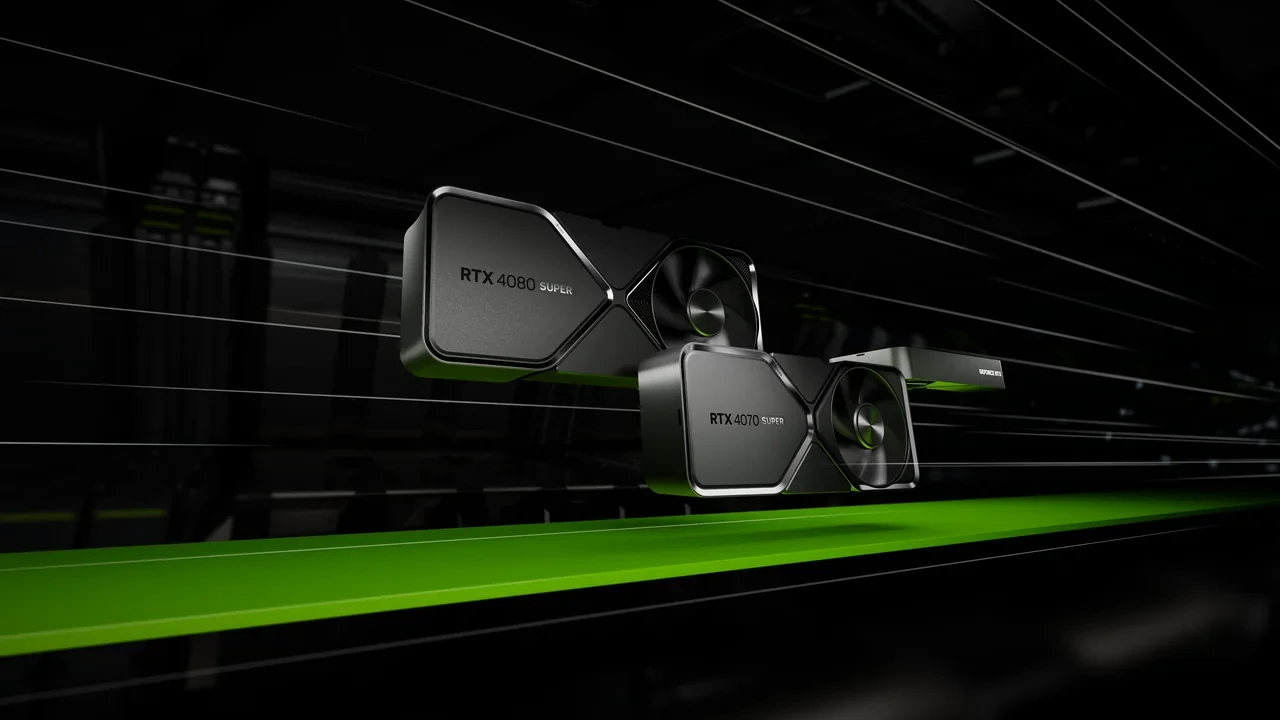
GeForce RTX 4090 D DLSS 5 compatibility: what game developers should plan around today
No official DLSS 5 support has been announced for the GeForce RTX 4090 D. NVIDIA documents the RTX 40 desktop family through DLSS 4.5, while DLSS 5 remains a research target rather than a released driver or SDK. Until a driver, SDK update, or RTX document names the 4090 D, studios should list the card as a DLSS 4.5 target.
That is enough to make current production decisions. A team can lock its shipping renderer, testing plan, and public wording without betting on a future NVIDIA release.
The RTX 4090 D is a separate desktop SKU
The GeForce RTX 4090 D is part of the RTX 40 desktop series, but it is not the standard RTX 4090. NVIDIA gave the D variant a different power profile and SM count while retaining the Ada-class ray-tracing hardware, Tensor Core generation, and media engines used by other RTX 40 desktop cards.
DLSS compatibility follows the hardware family and driver exposure rather than the product name alone. On features that are not limited by power or SM count, a build should behave much like it does on the wider RTX 40 desktop family. There is no reason to expect a 4090 D-only DLSS feature set.
DLSS features do not share one support switch
Each DLSS feature has its own SDK surface, runtime requirement, and GPU list. Separating them prevents a version label from becoming a vague promise.
- DLSS Super Resolution is a temporal upscaler exposed through the Streamline DLSS plugin. It reconstructs a higher-resolution output from a lower-resolution render.
- DLSS Frame Generation uses optical-flow hardware on Ada and later GPUs to insert a synthetic frame between two rendered frames.
- DLSS Ray Reconstruction runs an AI denoiser on Tensor Cores and replaces hand-tuned denoisers in supported ray-traced passes.
- DLSS 4.5 is the latest formally named RTX 40 desktop bundle, combining Super Resolution, Ray Reconstruction, and Frame Generation.
- DLSS 5 is the next announced generation, currently described by NVIDIA Research rather than a public driver or SDK release.
DLSS 4.5 has a known runtime, SDK header, parameter set, and hardware floor. DLSS 5 does not yet provide those production guarantees for the RTX 4090 D.
What counts as official support
A shipping integration needs a driver that exposes the feature, an SDK or plugin that recognises the GPU, NVIDIA RTX documentation listing the SKU, and at least one sample or released title demonstrating it. None of those four artifacts currently establishes DLSS 5 support on the RTX 4090 D.
The silicon may be capable of running the workload while the product remains unsupported because no validated driver exists. The 4090 D sits in that gap: it belongs to the relevant Ada family, but NVIDIA has not published a driver changelog, SDK update, or press release placing it in a DLSS 5 support set.
Capability and compatibility are different
Capability describes the silicon. Compatibility describes what the driver, SDK, and engine make available to a released game. The RTX 4090 D can run the Tensor Core work used by DLSS 4.5 and may be capable of DLSS 5 workloads if NVIDIA enables them, but that possibility is not a shipping contract.
I would not branch a renderer around a research demonstration. Keep DLSS 4.5 in production, monitor driver and SDK notes, and wait for a documented release before assigning DLSS 5 engineering work.
The documented feature set today
The RTX 4090 D already supports the features most studios need from DLSS: resolution scaling, ray-traced denoising, and frame-rate extension. NVIDIA documents that DLSS 4.5 surface across the RTX 40 desktop family. The public GeForce 40 series page provides hardware background, though NVIDIA’s own driver and SDK notes remain the binding sources.
A build can use Streamline or the engine’s maintained DLSS plugin, configure Super Resolution presets, add Ray Reconstruction to heavy ray-traced effects, and enable Frame Generation where frame pacing allows. Those choices remain valid if DLSS 5 later reaches the card.
How to read NVIDIA’s DLSS 5 material
NVIDIA Research explains the technique and research context. It does not replace a driver release, SDK release, or supported-GPU list. Benchmark leaks, retailer copy, and third-party speculation carry the same limitation.
For production work, require one of four things: a public driver changelog, RTX documentation update, SDK release note, or press release that names the RTX 4090 D. Anything else is commentary, however plausible.
DLSS generations relevant to the RTX 4090 D
The entries below describe documented support, not measured performance.
| DLSS feature set | Documented GPU generations | Runtime role | Production status on GeForce RTX 4090 D |
|---|---|---|---|
| DLSS Super Resolution (current SDK) | RTX 20, 30, 40, 50 series | Replaces a portion of the rendered frame with a higher-resolution output | Documented and supported through DLSS 4.5 |
| DLSS Ray Reconstruction | RTX 20, 30, 40, 50 series | AI denoiser for ray-traced effects, runs on Tensor Cores | Documented and supported through DLSS 4.5 |
| DLSS Frame Generation | RTX 40, 50 series (optical flow hardware on Ada and later) | Inserts a synthetic frame between two rendered frames | Documented and supported through DLSS 4.5 |
| DLSS 4.5 bundle | RTX 40, 50 series | Coordinated release of Super Resolution, Ray Reconstruction, and Frame Generation | Most recent named generation on the RTX 40 desktop family |
| DLSS 5 | Not listed in a public driver or SDK release for any specific SKU at the time of writing | Next-generation DLSS feature set described in research materials | No official DLSS 5 support announced for GeForce RTX 4090 D |
DLSS 4.5 and DLSS 5 are not interchangeable names. Treating them that way can leave a late-stage feature with no runtime support.
Engine choices for a DLSS 4.5 build
Use the documented DLSS 4.5 feature set through Streamline or the engine’s native plugin. Keep that dependency current so point revisions do not require a renderer rewrite and a later DLSS 5 addition can use the same integration boundary.
Spend engineering time on exposure controls, presets, profiling hooks, and steady frame pacing. Those survive an SDK transition; speculative render paths do not.
A production checklist for the RTX 4090 D
None of these tasks depends on DLSS 5 being available.
- Confirm the engine uses Streamline with the current DLSS 4.5 plugin, or the engine’s maintained native path.
- Lock the runtime to the version documented in the current SDK and record it in release notes.
- Profile Performance, Balanced, Quality, and Ultra Performance at the target resolution on the RTX 4090 D.
- Measure frame pacing with Frame Generation on and off, including input-to-photon latency when the tools are available.
- Enable Ray Reconstruction for the heaviest ray-traced passes and compare it with the previous denoiser in representative scenes.
- Archive GPU utilisation, frame time, and present metrics for every DLSS 4.5 preset.
- Track driver notes and SDK changelogs, allowing DLSS 5 work only after a documented driver or SDK release.
This gives any later DLSS 5 test a stable, reproducible DLSS 4.5 baseline.
Placing the card in a multi-GPU matrix
A PC build may also target the standard RTX 4090, RTX 4080 SUPER, a representative RTX 50 card, and an RTX 30 floor model. The same SDK and plugin cover RTX 40 desktop cards, with quality and performance adjusted for SM count and clocks. RTX 30 cards support Super Resolution and Ray Reconstruction but not Frame Generation in the same form, so that feature needs a fallback.
DLSS 5 may eventually use a similar family-wide baseline with differing feature parity, but no public document confirms that. For now, list the RTX 4090 D as DLSS 4.5 hardware and put DLSS 5 in a dated tracking note rather than a promised feature column.
Monitor releases without opening a development branch
- Read the “Added” and “Fixed” sections of RTX 40 desktop driver notes, not only the marketing summary.
- Track Streamline release notes and DLSS plugin history for a new generation entry.
- Revisit NVIDIA Research for changes in scope or supported hardware.
- Tag the existing DLSS 4.5 baseline in source control so the next SDK can be diffed rather than rebuilt.
- Record the date and exact wording of the first official DLSS 5 capability statement.
This is release monitoring, not speculative renderer work.
The RTX 4090 D in studio hardware planning
The card belongs in the target or stretch row of a floor-target-stretch matrix. Evaluate it against DLSS 4.5 and keep DLSS 5 as an unannounced future row. If NVIDIA later changes the driver and SDK support, the monitoring record will already contain the relevant notes.
That also answers why a build does not advertise DLSS 5: the documentation, driver, and SDK do not list the RTX 4090 D.
Questions that come up in production reviews
- Is the RTX 4090 D a DLSS 5 GPU? No official support has been announced. Its documented feature set runs through DLSS 4.5.
- Is it the same as an RTX 4090? No. It is a separate RTX 40 desktop SKU with a different power profile and SM count.
- Can it run an internal DLSS 5 experiment? Ada-class experiments do not establish official support. Production decisions still require a documented driver or SDK.
- What is its latest official DLSS generation? DLSS 4.5 Super Resolution and Ray Reconstruction, plus Frame Generation.
- Where should support be checked later? NVIDIA driver notes, the Streamline changelog, and NVIDIA Research publications.
Risks of planning around an unannounced feature
Premature renderer refactoring creates a parallel path that drifts from the main code. Adding DLSS 5 to the QA matrix too soon spends testing time on a moving target. Promising it in marketing creates support tickets when the driver cannot deliver. Monitor the feature, but do not treat it as shippable until NVIDIA documents the SKU.
Feature parity across nearby GPU targets
This matrix is descriptive and should be updated only from specific driver, SDK, or NVIDIA press material.
| Target GPU | DLSS Super Resolution | DLSS Ray Reconstruction | DLSS Frame Generation | DLSS 5 (documented support) |
|---|---|---|---|---|
| GeForce RTX 4090 D | Documented through DLSS 4.5 | Documented through DLSS 4.5 | Documented through DLSS 4.5 | No official DLSS 5 support announced |
| GeForce RTX 4090 | Documented through DLSS 4.5 | Documented through DLSS 4.5 | Documented through DLSS 4.5 | No official DLSS 5 support announced for this SKU |
| GeForce RTX 4080 SUPER | Documented through DLSS 4.5 | Documented through DLSS 4.5 | Documented through DLSS 4.5 | No official DLSS 5 support announced for this SKU |
| GeForce RTX 50 series (representative) | Documented through DLSS 4.5 | Documented through DLSS 4.5 | Documented through DLSS 4.5 | Confirm against current driver and SDK release notes |
| GeForce RTX 30 series (floor model) | Documented through DLSS 4.5 | Documented through DLSS 4.5 | Not supported in the same form on this generation | No official DLSS 5 support announced for this generation |
The first three feature columns are available now. The DLSS 5 column remains open until an official source says otherwise.
A sensible order for first-time integration
Use one DLSS 4.5 plan across the RTX 40 desktop family and keep a Frame Generation fallback for older cards. Integrate Streamline, expose all four quality presets, lock the runtime, and profile Frame Generation on and off at the target resolution. Then file one readiness ticket whose acceptance criterion is an NVIDIA driver, SDK, or RTX document naming the RTX 4090 D.
Frequently asked questions
Does the GeForce RTX 4090 D officially support DLSS 5?
No. NVIDIA has not published a driver, SDK, or RTX documentation entry that includes the card. DLSS 4.5 remains its documented feature set.
What is the difference between DLSS 4.5 and DLSS 5?
DLSS 4.5 is a public SDK bundle of Super Resolution, Ray Reconstruction, and Frame Generation. DLSS 5 is a separate announced generation described by NVIDIA Research, with no published RTX 4090 D feature set or hardware list.
Is the RTX 4090 D the same GPU as the RTX 4090?
No. It uses the same Ada-class architecture but has a different SM count and power profile. Driver support follows the architecture and NVIDIA’s published product rules.
Can a build still use DLSS on the RTX 4090 D?
Yes. Streamline or the engine’s native plugin can expose DLSS 4.5 Super Resolution, Ray Reconstruction, and Frame Generation without waiting for DLSS 5.
Where can a developer check for later DLSS 5 support?
Check RTX 40 driver notes, the Streamline changelog, DLSS plugin history, and NVIDIA Research publications. Revise the target only when an official channel names the SKU.
Should the engine team refactor for DLSS 5 now?
No. A parallel path with no supported runtime is likely to drift. Keep DLSS 4.5 in production and wait for documentation.
Will a future driver unlock DLSS 5?
Possibly, because the card is an Ada part targeted by the research, but NVIDIA has not confirmed it. Re-evaluate if a driver, SDK, or press release adds the model.
Does the RTX 4090 D support Frame Generation and Ray Reconstruction?
Yes. Both belong to DLSS 4.5. Frame Generation uses Ada optical-flow hardware, while Ray Reconstruction uses the Tensor Core path.
What is the safest DLSS feature to ship now?
Super Resolution has the broadest testing and documentation. Add Ray Reconstruction for ray-heavy titles and Frame Generation where frame pacing permits. All three are DLSS 4.5 features.
How should marketing describe DLSS on the RTX 4090 D?
Name the documented DLSS 4.5 features. Do not mention DLSS 5 unless NVIDIA publishes a driver or SDK that adds it to the card.


Leave a Reply