
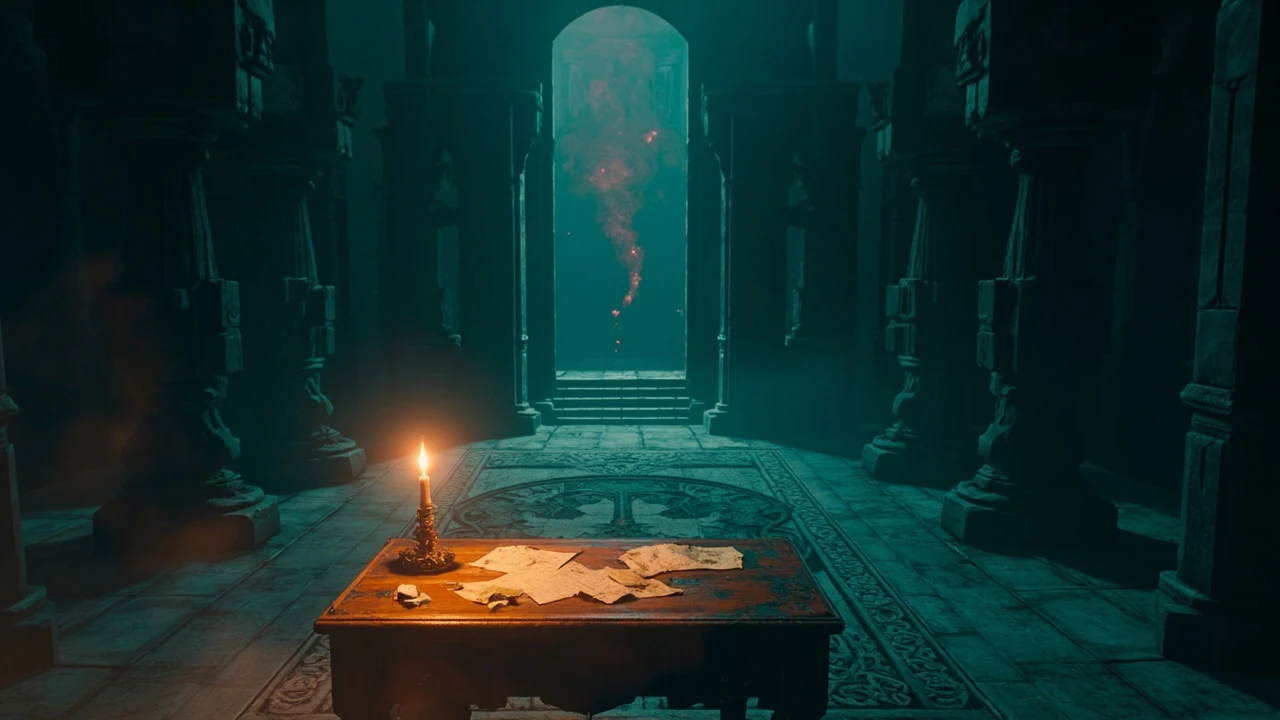
Contradiction Crimson Desert: what the quest actually asks of the player
The contradiction crimson desert encounter is one of the more distinctive quest beats in Pearl Abyss’s open-world RPG, and it lands hardest on writers and quest designers because it has almost no combat. A wandering scholar invites the player character into a quiet room and then challenges them to a verbal duel: a series of statements about the world, the player’s recent choices, and the situation at hand, where the player must decide which lines are true and which are lies. The reward is information that opens a downstream branch, and the cost of a wrong answer is a closed door or a hostile relationship with an NPC. Because the mechanic is so small and so story-driven, it is also one of the cleanest design references available for studios trying to ship meaningful non-combat content in a large world.
This article treats the encounter as a design case study rather than a walkthrough. The aim is to break down how a short, dialog-heavy puzzle is built to feel like a real quest inside a sprawling open world, what design decisions a studio can borrow, and where the pattern breaks if it is copied without adaptation. A verified external reference is used only to anchor the encounter’s structure; everything else is editorial reasoning aimed at quest writers, narrative designers, and producers shipping open-world content in Unreal Engine, Unity, or proprietary engines.
Why the contradiction crimson desert encounter matters to quest designers
Open-world games live or die on the texture of their side content. A player can forgive a flat main quest if the world itself is full of small, well-built moments, and a single weak side encounter can quietly drag a region down. The contradiction crimson desert quest is interesting because it solves a problem many open-world projects struggle with: how do you give a player a satisfying challenge when the rest of the game is built around melee combat, traversal, and resource loops?
The encounter asks for attention rather than reflexes. It rewards players who have been paying attention to dialog, faction context, and small environmental cues earlier in the game. That makes it a strong case study in three areas that matter to developers:
- Non-combat quest design inside a combat-driven open world.
- Puzzle-as-dialog systems that scale to multiple encounter types.
- Reward and consequence design that ties a small puzzle to a larger world state.
Each of these is a place where open-world projects regularly lose development time to iteration, and the contradiction crimson desert design offers concrete answers to each.
Designing non-combat quests for a combat-driven world
Most open-world RPGs are built around a primary verb. Crimson Desert is built around combat, traversal, and gathering. The contradiction quest is interesting precisely because it asks the studio to design outside that primary verb without breaking the player’s sense of place. Three design moves make this work.
1. The encounter respects the world it lives in
The scholar’s room uses the same visual language as the rest of the game: stone, cloth, warm light, a subtle sense of age. A quest designer who drops a brightly lit puzzle terminal into a medieval-looking space creates a visual and tonal seam. The contradiction encounter hides inside the world’s grammar, so the player does not feel they have left the game to solve a different game.
For studios, the practical lesson is that a non-combat quest should reuse the world’s existing asset budget, lighting, and audio language. If the non-combat quest needs a new art style, a new sound layer, and a new UI to feel coherent, the cost of that content tends to grow faster than the design value it returns.
2. The encounter is short on purpose
The puzzle is designed to last a few minutes, not a few hours. The player walks in, hears a short framing line, makes a small number of choices, and walks out with a new piece of world knowledge. This matters for two reasons. First, a long non-combat quest fights the pacing of a game whose main loop is exploration and combat; players will feel the detour. Second, a short encounter is cheaper to build, localize, and test, which is the difference between shipping a handful of these quests in a region and shipping none of them at all.
For a production team, the rule of thumb is: a non-combat quest in a combat-driven open world should cost less than a small combat encounter in QA and localization time, and should not exceed the average travel-and-fight loop in play time. The contradiction quest meets both targets.
3. The encounter uses a mechanic the player already has
The player already listens to dialog. The puzzle asks them to use that same channel for a different purpose. There is no new input, no new UI to teach, no new resource to manage. A quest designer who invents a fresh input layer for a side quest creates friction; the contradiction quest is friction-free because it borrows the existing conversation system.
For developers, the lesson is that non-combat quests should prefer mechanics that already exist in the player’s muscle memory. Conversation, observation, light inventory checks, and short traversal puzzles are usually cheaper and more legible than bespoke mini-games.
The structure of the contradiction crimson desert puzzle
Looking at the encounter as a system, it is built from a small set of reusable parts. The verified reference describes the encounter as a series of statements the scholar makes, with the player judging each one as true or false. That structure can be broken into a clean production model.
Statement set as quest data
Each puzzle is a list of statements. In production terms, this is a small data table: speaker ID, statement text, audio cue, correct answer, and consequence flag. Designing the puzzle as data, rather than as a hand-scripted dialog tree, lets writers iterate faster, lets localization retranslate without breaking logic, and lets QA test answers in isolation. A small indie team can implement this in a few days with a basic scripting system, while a larger studio with a dedicated quest editor can ship it in a single sprint.
Truth sources and falsifiability
The puzzle only works if the player has a way to evaluate each statement. In a well-designed open-world quest, that evaluation can come from three sources, used together or separately:
- Earlier dialog the player has actually heard, without forcing the player to backtrack or read codex entries.
- Observable world state, such as an NPC still being alive, a building still standing, or a faction flag set by a prior quest.
- Logical inference, where the structure of the statements themselves reveals contradictions.
The contradiction crimson desert encounter uses a mix of these. Some statements are testable from prior context, others from what the player sees in the room. A quest designer copying the pattern should plan, for each statement, which source of truth the player is supposed to use. If no clear source exists, the statement will feel arbitrary and the player will rightly resent the guess.
Consequence design: what a wrong answer costs
Wrong answers in the encounter do not kill the player. They close a door, shift an NPC’s disposition, or remove a piece of information from the player’s available set. That choice is deliberate. A lethal or run-ending failure on a side quest pushes players toward looking up the answer rather than engaging with the design. A consequence that changes the experience but does not block it preserves the player’s sense of agency.
For quest teams, the rule is to pick a consequence that the player notices, that they care about, and that is recoverable. Closing a non-critical branch, marking an NPC as disappointed, or denying a small reward are usually safer than blocking a quest or sending a faction hostile.
How the encounter connects to the wider world state
Open-world side quests are most valuable when they touch the same systems the main quest uses. The contradiction crimson desert encounter is a good reference because it does exactly that: the result feeds into a downstream branch, an NPC’s memory, and possibly a small reward.
For developers, this is the part of the design that usually costs the most time, because it requires coordination between quest, AI, dialog, and progression systems. The simplest production pattern is to expose a small number of named flags from the encounter, and let downstream systems react to those flags. A studio building a quest editor should expose flag wiring as a first-class feature; a small team without that tooling can fall back on named booleans in script, with the awareness that flag sprawl becomes a long-term maintenance risk.
Production constraints a quest team should plan for
Designing a few of these encounters is straightforward. Designing a region of them is a different problem. A For additional context, team planning to ship contradiction-style content across an open world should expect to budget for the following.
Authoring and review time
Each encounter is short to play but expensive to write well, because every statement needs a verifiable truth source. Plan for one statement to require roughly the same editorial review as a paragraph of main-quest dialog. A small studio aiming for a dozen encounters should expect to budget writing time accordingly.
Localization and audio
Statements are read aloud in many open-world RPGs. That makes each statement both a translation unit and a voice-recording unit. The shorter the statement, the cheaper it is, which is one reason the encounter keeps its lines short. A team that lets statements drift toward full paragraphs will see localization and VO costs rise quickly.
QA scenarios
Each statement is a fork. An encounter with six statements and two answer choices per statement already creates a large number of branches when combined with prior world state. QA needs to know which branches are reachable, which are user-visible, and which are dead. A small state machine in the quest editor, or even a spreadsheet of reachable combinations, will save QA time compared to ad hoc testing.
Reward balance
If the encounter is too rewarding, players will farm it. If it is too thin, players will skip it. The encounter in Crimson Desert threads this needle by rewarding information and small progress rather than gear. A studio should be ready to tune reward tables across a region, not per encounter, to keep the world feeling consistent.
Comparing contradiction-style quests with other non-combat designs
Non-combat open-world quest design is not new. The contradiction crimson desert encounter is one of several common patterns, and it is worth seeing how it compares to the alternatives a team might consider.
| Pattern | Player verb | Typical cost | Replay value | Best fit |
|---|---|---|---|---|
| Contradiction / truth-lie dialog | Listen and judge | Low per encounter, scales with statement count | Low once solved | Short, story-rich beats in dense regions |
| Escort or protect NPC | Move and fight | Medium due to AI and pathing | Medium | Combat-heavy open worlds that need character focus |
| Environmental puzzle room | Observe and manipulate | High due to bespoke level design | Low once layout is learned | Dungeons, shrines, and exploration set-pieces |
| Fetch or delivery chain | Travel and trade | Low to medium | Low | Region padding and faction grinding |
| Choice-driven conversation tree | Read and choose | Medium to high in writing time | Medium through alternate branches | Main quest and companion arcs |
The table is not a ranking. Each pattern has a place. The contradiction pattern is attractive because it sits in the lower-left of cost and adds a verb most open-world RPGs underuse: careful listening. A team should not replace other patterns with it, but it is a strong option for the parts of the world that need texture without adding traversal cost.
A second comparison: production risk across the same patterns
Cost alone is a weak basis for picking a pattern. Production risk, defined as the chance that a quest of a given type ships late, breaks in QA, or never reaches a region, matters as much as raw authoring time. The table below reframes the same five patterns through a production-risk lens, using the common failure modes seen in shipped open-world titles.
| Pattern | Main production risk | Typical failure mode | Mitigation in practice |
|---|---|---|---|
| Contradiction / truth-lie dialog | Unverifiable statements | Player cannot judge truth, resorts to a guide | Write truth source before statement, playtest blind |
| Escort or protect NPC | AI pathing and aggro | NPC blocks geometry or dies from off-screen enemies | Use navmesh test passes, bound AI to safe corridors |
| Environmental puzzle room | Layout and prop state | Player soft-locks after a missed interaction | Reset scripts on every prop, add a hint layer |
| Fetch or delivery chain | Waypoint and pacing | Player runs across the map for a single item | Cluster objectives, add fast travel hooks |
| Choice-driven conversation tree | Branch explosion | QA cannot cover reachable states | Cap branch depth, use flag pruning in the quest editor |
Read together with the cost table, the two views suggest where contradiction-style content earns its place. It is cheap to produce, the failure modes are narrow, and the mitigations are obvious to a team that has shipped any dialog content before. That is a useful combination in a genre where side content is the largest line item in a production schedule.
Common failure modes when copying the pattern
The pattern is simple enough that it is tempting to clone it directly. In practice, several failure modes appear when the pattern is copied without the design context.
Statements without verifiable sources
The single most common failure is statements that cannot be checked. The player is asked to judge something the game has not actually told them. The result feels unfair, and the encounter is remembered as a low point rather than a high point. The fix is to write statements only after the truth source is identified, not before.
Consequence that blocks progress
A second failure is making a wrong answer block the main quest or send a major faction hostile. Players will detect this quickly, and the encounter will be skipped by anyone who reads a guide. The pattern works best when the consequence is local and recoverable.
Statements that demand too much prior knowledge
Long-running open-world RPGs accumulate lore. A statement that depends on a small detail from a quest twenty hours earlier can feel cheap rather than rewarding. The fix is to keep truth sources close to the encounter, in either time or geography, so the player can reasonably be expected to remember them.
Encounters that all feel the same
If every scholar in the world runs the same puzzle, the pattern stops feeling like a discovery and starts feeling like a chore. Variation can be introduced by changing the truth source, the speaker’s disposition, or the consequence, without changing the underlying mechanic.
Reward mismatch
Rewarding the encounter with high-value loot makes it mandatory farming content. Rewarding it with nothing makes it ignorable. The encounter in Crimson Desert threads this by rewarding narrative progress, which fits the kind of player who is there for the story. A team should be ready to adjust reward tables as playtest data comes in.
A practical checklist for a team shipping contradiction-style content
For a team planning to ship a small set of these encounters in a region, the following checklist covers the design and production questions that tend to come up.
- For each encounter, list the truth source of every statement before writing the statement itself.
- Keep the number of statements low, in the range of four to eight, to control play time and QA cost.
- Reuse the existing conversation and audio systems. Avoid bespoke UI or new input verbs.
- Pick a consequence that is local, observable, and recoverable. Avoid blocking or run-ending outcomes.
- Expose the encounter’s outcome as named flags, and design at least one downstream system to react to those flags.
- Plan localization and VO cost as part of the encounter budget, not as an afterthought.
- Playtest with players who have not read a guide, and watch for statements that are unverifiable or that demand too much prior knowledge.
- Tune rewards per region, not per encounter, so the world feels consistent.
Teams that follow a checklist like this tend to ship the pattern at a consistent quality level. Teams that do not will find that some encounters feel excellent while others feel punitive, and players will notice the difference.
Where the pattern stops scaling
No design pattern scales forever. The contradiction crimson desert pattern is well suited to small, dense regions with a high density of story-driven content. It scales less well in a region where players are mostly passing through, because the encounter rewards attention and the player may not be ready to slow down. It also scales less well as the player’s main motivation shifts toward combat or progression, because the encounter offers neither.
A team planning a region with low content density should pair the pattern with a different non-combat quest, such as a short observation puzzle, to keep variety. A team planning a region for high-level combat players should consider whether the encounter’s reward is meaningful for that audience at all. Honest design means admitting when a pattern is the wrong fit, not forcing it into every district.
What the pattern suggests about the future of open-world quest design
There is a broader signal in encounters like the contradiction crimson desert quest. Open-world RPGs are slowly moving away from a single main verb, even when their combat systems are excellent. Players have shown, across a generation of releases, that they reward worlds that ask them to think in more than one way. The contradiction pattern is one of several that point in that direction, alongside environmental puzzles, observation quests, and lightweight social sims inside RPG systems.
For studios, the practical takeaway is that investing in a small toolkit of non-combat quest patterns pays off across an entire game. The toolkit does not need to be large. Two or three well-designed patterns, used with restraint, will do more for a world’s texture than a dozen generic fetch quests. The contradiction pattern is a strong candidate for any toolkit, because it is cheap to build, reuses systems the player already has, and rewards the kind of player who is most likely to talk about the game after the credits roll.
Frequently asked questions
What is the contradiction crimson desert encounter?
It is a short, dialog-driven quest in Pearl Abyss’s open-world RPG in which a scholar presents the player with a series of statements and asks the player to judge each one as true or false. Correct judgments open a downstream branch; wrong answers shift the scholar’s disposition and close some of the player’s options. The encounter is built around listening and inference rather than combat.
Is the contradiction crimson desert quest a combat encounter?
No. The encounter contains no combat, no traversal challenge, and no resource management. The player’s input is a judgment call on each statement, made through the existing conversation system. The design treats the conversation channel as the gameplay surface for that part of the world.
How long does the contradiction crimson desert puzzle take to complete?
Players typically spend a few minutes inside the scholar’s room, including the framing dialog. A more important metric for quest designers is the authoring cost, which scales with the number of statements and the number of truth sources used, rather than with the player’s play time.
What rewards does the contradiction crimson desert quest give?
The primary reward is information and downstream quest access. The encounter also affects the scholar’s disposition, which influences later dialog and possibly a small in-world reward. The pattern is built to reward narrative progress, not gear, which is one reason it does not become mandatory farming content.
Can a small studio ship contradiction-style quests in a proprietary engine?
Yes. The pattern only requires a quest flag system, a small data table for statements, and an existing conversation system. A team without a dedicated quest editor can implement the pattern with named booleans in script, with the understanding that flag sprawl is a long-term maintenance risk and should be tracked in a shared design document.
How does the pattern fit into a larger open world?
Contradiction-style encounters work best in dense, story-rich regions where the player is already engaged with the world’s dialog and lore. In a sparse region or one aimed at combat-focused players, the pattern can feel out of place, and a different non-combat quest type will fit better. Mixing patterns across a world is usually stronger than relying on a single design.
What is the biggest design risk in copying the pattern?
The biggest risk is statements that the player has no way to verify. When truth sources are unclear, the encounter feels like a guess, and players will rightly resent it. Writing the truth source first and the statement second is the simplest way to avoid this failure mode.
How should a team test contradiction-style quests in QA?
QA should test the encounter with a player who has not read a guide and has not done a detailed playthrough of prior quests in the region. The test should focus on whether each statement is verifiable, whether the consequence is observable, and whether a wrong answer is recoverable. Branch coverage should be tracked in a reachable-state document, not in ad hoc test cases.
Does the contradiction pattern work in multiplayer open worlds?
It can, with adaptation. The main risks are synchronization of world state across clients, cheat exposure if judgments are made client-side, and reward duplication if multiple players can solve the same encounter. A server-authoritative flag model, with client display only, is the safer default; any reward should be granted once per group rather than per player.
Where can I see a clean reference for the encounter’s structure?
The For additional context, Contradiction Walkthrough: Institute Steward Answers page on Game8 documents the structure of the encounter as a series of statements with right and wrong answers, which is a useful reference for any team planning to design or analyze a truth-and-lie quest.






Leave a Reply