
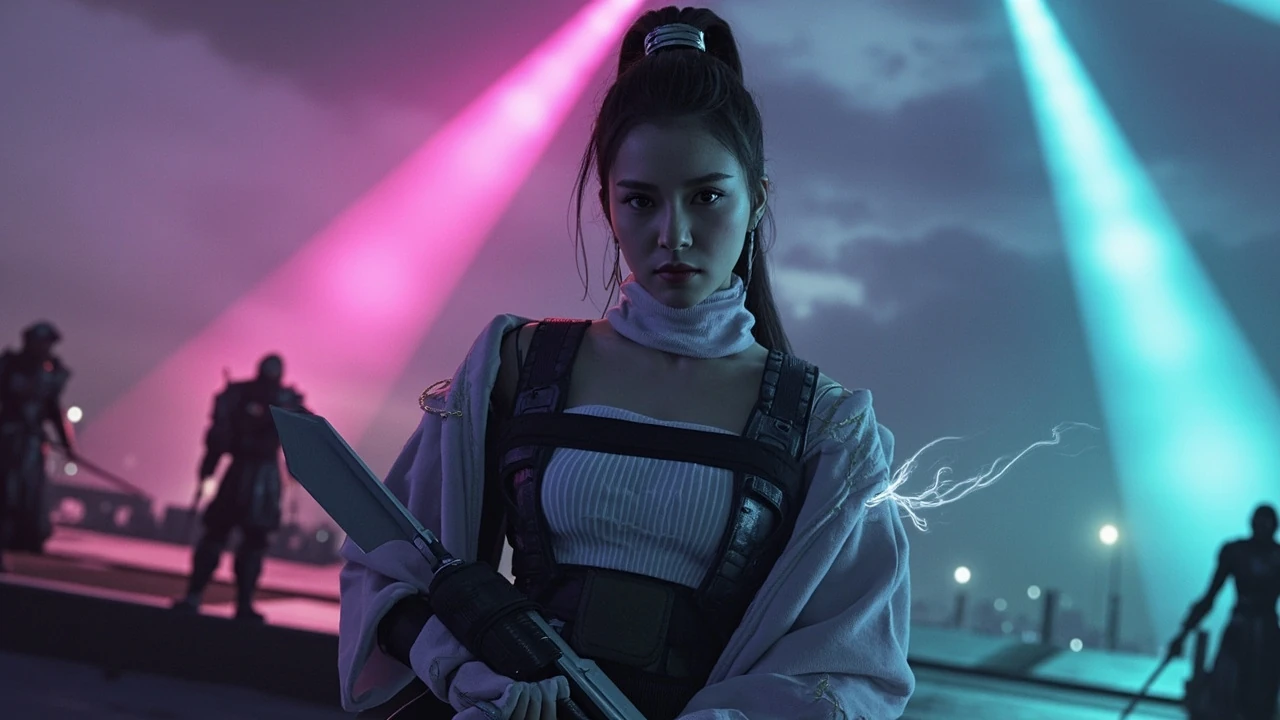
Rumi KPop Demon Hunters: Character design and production context
Every working pop group has a front, and every working demon-hunting squad has a lead. Rumi in KPop Demon Hunters holds both jobs at once. She is the vocalist whose voice locks the Honmoon, the daughter of a demon father whose hidden lineage drives the first season’s drama, and the character around whom the combat stance, camera focus, and ability kit of any adaptation will be built. Studios that want to use this property well have to make their decisions about Rumi before they decide anything else, because combo balance, mission gating, narrative pacing, and music selection all fall out of how she is defined.
This page is written for a working game developer, technical artist, or systems designer who needs a concrete read on Rumi as a character system. It walks through the 2025 Netflix animated film, the surrounding media context, the design patterns Rumi naturally suggests, and the practical lessons a studio can carry into a rhythm-action, hero-shooter, or narrative-action project built on the same DNA.
Who Rumi is in the source material
Rumi is one of the three protagonists of the Sony Pictures Animation feature KPop Demon Hunters, which premiered on Netflix on June 20, 2025, directed by Maggie Kang and Chris Appelhans. The film is the seed for a wider franchise that already includes a soundtrack release and licensed merchandise. Her name appears first in the cast list, her solo is the visual climax of the show, and her interior conflict as a half-human, half-demon performer is the engine of the story.
For a developer, the structural point is that Rumi is the character the audience projects onto. Mira is the muscle, Zoey is the heart, and Rumi is the thesis statement. The film is explicit about this. In press tied to the audition cycle, Arden Cho, who voices Rumi, has described the role as the most layered of the trio, and production commentary has consistently framed Rumi’s arc as the spine of the project. That structural choice is what makes Rumi a useful case study: a title that puts a conflicted mixed-heritage performer at the center is making a deliberate narrative bet, and any game adaptation has to decide whether to mirror or rewrite that bet.
Voice, performance, and the half-demon dilemma
The defining trait of Rumi is that she is half demon. She hides her pattern, the visible marks of her demon lineage, behind sleeves, makeup, and performance lighting. The dramatic question of the film is whether that concealment can hold, and the dramatic question of any game adaptation is whether the player can feel that concealment mechanically rather than only as a scripted cutscene.
Three patterns from the source material translate cleanly to a player-facing system.
- Visibility gating. Rumi’s demonic marks pulse during high-intensity musical moments. A game can tie ability cooldowns or combo multipliers to a pattern meter that the player can suppress but never fully erase. A single meter carries the dual-identity premise without needing a separate mechanic for every scene.
- Stage versus street identity. The film cuts between polished stage performance and rougher supernatural combat. A game can split Rumi’s moveset into a stage kit of formations, buffs, and audience-driven finishers, and a street kit of stealth, raw power, and improvised finishers, then gate stage abilities behind a publicly visible health state and street abilities behind a hidden one.
- Vocal attack as a real weapon. Rumi’s voice is the seal on the Honmoon. Translated into a game, that means an audio-driven ultimate that combines rhythm input, a cinematic camera, and a temporary world-state change, rather than a generic beam or explosion that ignores everything the character has been about.
None of these are invented. They are mechanical readings of the elements that already define the character. A strong source character makes the systems designer’s job easier, because the rules are sitting on the surface waiting to be encoded.
Combat role in a three-character squad
Rumi is the leader of a three-hunter squad, with Mira and Zoey as her partners. The trio covers each other on stage as a K-pop group and in combat as demon hunters. In a game, that is a classic trinity design problem: one of the three has to own the moment-to-moment feel of the encounter, one has to own the opener, and one has to own the cleanup.
| Role | Source character | Gameplay niche | Why it fits |
|---|---|---|---|
| Anchor and protagonist | Rumi | Mid-range duelist with rhythm-tied specials | Long solos and dramatic beats give her the most screen time and the most cinematic finishers |
| Opener and bruiser | Mira | Aggressive rush-down with high burst, lower sustain | Stage presence and combat confidence read as immediate pressure |
| Cleanup and support | Zoey | Area control, marks, and team buffs | Heart-of-the-group framing fits a character who enables rather than headlines |
This split is not the only valid reading. A cooperative three-player game could invert it, putting Rumi on crowd control and Mira on duels, and the source material would not contradict that. The simplest and most defensible mapping is the one above, because it mirrors how the film uses its runtime. Rumi gets the long takes, the slow builds, and the climactic solos, and a game that follows the same blueprint inherits the same emotional payoff.
Signature abilities and their game-readable analogues
Several of Rumi’s on-screen abilities have obvious mechanical translations. The list below is not exhaustive; it focuses on the abilities a designer can lift from the film and tune without redesigning the character.
- Honmoon seal. A vocal performance that locks demons out of a region. As a game ability, this becomes a stationary channel with rhythm input: the player holds a position, the camera pulls wide, and the resulting seal zones out enemy reinforcements for a short window. It is Rumi’s signature and should be the most cinematic ability in her kit.
- Pattern surge. Rumi’s demonic marks flare during moments of high emotion, granting raw power. As a game ability, this is a timed buff the player accepts consciously, paying a long cooldown or a visible team debuff for a short window of elevated damage. The cost is what makes the ability interesting; a free power spike would erase the identity tension.
- Stage and street split stance. Two movesets with different audio and visual language. The mechanic is the player’s reward for learning the kit, because stance switching is where the depth lives.
These three abilities are enough to design a first encounter around Rumi. They map to the standard trinity of opener, sustain, and finisher, and they preserve the source material’s emphasis on Rumi as a character whose combat identity and stage identity are the same identity.
Camera, animation, and the performance budget
Performance animation is where KPop Demon Hunters spends a disproportionate amount of its craft. Choreography, costume physics, and lighting on stage take a frame budget that most action films would spend on additional cuts. A game adaptation that wants to feel faithful has to make a matching budget decision early, and the production profile of the film makes clear that this was already a project built around on-stage moments rather than voice-over exposition.
| Element | Film treatment | Game implication | Risk if under-built |
|---|---|---|---|
| Choreography | Full dance numbers in long takes with weight and breath | Motion-captured dance layers blended with combat, retargeted to the playable rig | Combat feels generic, stage moments feel stiff |
| Costume | Coordinated pieces that change with each performance | Modular costume system tied to combat passives, with cosmetic layers and stat layers separated | Progression feels shallow, fans reject the wardrobe |
| Lighting | Magenta, teal, and warm stage wash as emotional cues | Per-ability color grammar that matches the film palette and signals stance switches | Abilities blur into each other, cinematic finishers lose impact |
| Lip sync and vocal | Performance recorded and rendered for full songs | Live-recorded vocal takes routed to a real-time vocal animator for stage scenes and a stylized layer for combat | Stage scenes feel canned, the rhythm hook weakens |
The Rumi kit is the place where these budgets collide. She is the character who uses every one of these systems at once. A team that budgets for Rumi’s combat and underestimates her stage moments will ship a competent action game and a flat adaptation.
Rhythm as a system, not a gimmick
The film’s most exportable idea is that music is not a backdrop; it is a weapon. Rumi’s voice can literally lock demons out of a region. That is a strong narrative premise, but it is also a clean mechanical premise. There are three reliable ways to encode it.
- Rhythm-window combat. Core attacks use normal action inputs; special attacks succeed or upgrade when they land inside a beat window. This is the most familiar version and the easiest to tune, but it can feel like a tax on players who do not internalize the soundtrack.
- Phase-locked arenas. The combat arena itself has rhythm: enemy waves, environmental hazards, and team buffs all align to the music. The player is not timing individual attacks to a beat, but the whole fight feels musical. This is harder to design but rewards players who care about staging more than inputs.
- Adaptive soundtrack. The track shifts in response to combat state. Successful combos add layers, missed combos strip them, and a final-phase transformation brings in a full arrangement. This is the most cinematic version, but it depends on a music pipeline that can change in real time and is the most expensive to build.
Rumi is the right character to carry any of these systems because the source material already makes the case. The wrong move is to bolt a rhythm layer onto a generic action game and call it a K-pop adaptation. The right move is to choose a system, design Rumi’s kit around it, and let the rest of the cast inherit the rules.
Narrative pacing around a mixed-identity protagonist
The film’s dramatic engine is simple: Rumi wants to be fully accepted by the hunters and the audience, and she cannot be, because her father is a demon. That is a fundamentally different protagonist shape from Mira or Zoey, and it forces a specific pacing pattern on the campaign.
- Early chapters keep the secret. The player learns the stage kit first, with hints that something is gated. Rumi performs, the group performs, and the team shines.
- Mid chapters pressure the secret. Difficult encounters and personal arcs force Rumi to use her pattern surge. The visible cost lands because the player has lived through the easier version first.
- Late chapters expose and reclaim the secret. The Honmoon seal and the final fight are designed as a single long performance in which Rumi uses every system the player has learned. The arc closes because the player has been rehearsing for it without knowing.
This is the same shape as a long RPG, a roguelike run, or a three-act action game. The interesting question for a developer is whether the game will let the player feel the reveal or whether the reveal will be locked behind a cutscene. The source material argues for the former. Rumi is a character whose most important moments are performances, and a game can turn those performances into playable systems rather than cinematic-only beats.
Building Rumi’s moveset: a practical checklist
Below is a checklist a designer can use to evaluate a first-pass Rumi kit before playtest. Each item is phrased as a yes-or-no test against the source material.
- Does the neutral attack string feel like a stage performance, with weight changes that read as choreography rather than as a generic sword or fist combo?
- Is there at least one ability whose cost is the team seeing Rumi’s true nature, whether that shows up as a visible debuff, a long cooldown, or a phase shift, and is the cost communicated to the player before they take it?
- Does the ultimate ability combine voice, camera, and a world-state change, rather than reading as a generic beam or explosion?
- Is the stage-versus-street stance switch real, meaning each stance has unique cancels, frame data, and team interactions, not just a visual swap?
- Does the kit reward learning the soundtrack, whether through rhythm-window combat, phase-locked arenas, or adaptive audio?
A kit that answers yes to at least three of those items will read as Rumi. A kit that answers no to all five is almost certainly a generic action protagonist wearing Rumi’s name.
Multiplayer and live-service considerations
KPop Demon Hunters is a film with a clear protagonist hierarchy, not an open roster. That creates a specific challenge for any live or multiplayer adaptation. A team cannot ship a Rumi-led game and then balance a six-versus-six mode around a character whose identity is the one who performs and the one who hides. The options are constrained.
| Mode | Rumi’s role | Design pressure |
|---|---|---|
| Three-player co-op campaign | Anchor, plays like a stage leader with mid-range combos and aura buffs | Mode must keep the trio together as a unit or it breaks the source |
| Three-versus-three arena | Duelist with stage stance, balanced around her pattern meter as a visible and counterable resource | Pattern meter must be readable to opponents or Rumi’s half-demon nature becomes unfair in PvP |
| Solo roguelike | Versatile mid-range, with stage and street versions as alternate builds | Roster has to expand to fill the gap left by Mira and Zoey, which contradicts the trio framing |
| Async or seasonal content | Featured performer in set-piece events, with cosmetic and music drops | Music and costume pipelines must keep up with event cadence |
The clearest path is three-player co-op with Rumi as the default lead, because the source material is built around a trio. Arena modes are a reasonable second step, but they require a clear read on the pattern meter as a visible, punishable resource. A solo game around Rumi alone is the most ambitious option, because it forces the studio to encode Mira’s and Zoey’s contributions into Rumi’s own kit or risk a thin solo experience.
Costume, cosmetics, and wardrobe as a progression layer
Rumi’s wardrobe is one of the most discussed parts of the film. Coordinated stage outfits, signature colors, and visible demon marks are all part of how the audience reads the character. A game that treats costume as decoration will leave engagement on the table. A game that treats costume as a progression layer has to separate three things, and the production commentary around Arden Cho’s audition and Rumi’s role reinforces how carefully the wardrobe has been tracked against the character arc.
- Cosmetic layers. Outfits, hair, makeup, and accessories. These do not change gameplay and exist for expression, social signaling, and brand tie-ins.
- Stat layers. Passives, set bonuses, and synergy effects tied to wardrobe choices. These need clear rules and visible sources, or players will treat them as random.
- Lore layers. Outfits that change how NPCs and the world react to Rumi. For a character whose identity is what others can see, this is a real system, not a flavor text exercise.
That third layer is specific to Rumi and is the one most often missed. A team that wants the adaptation to feel like the film has to plan for the world to react when Rumi is in stage gear versus street gear versus an outfit that reveals her pattern. That is a content and writing cost, and it shows up early in production.
Audio and music pipeline for a Rumi-led game
The film’s soundtrack is a real product with a real release, and it has been the subject of merchandising and charting coverage. A game adaptation cannot treat audio as a polish layer. The audio pipeline has to be designed alongside the combat system, because Rumi’s abilities are audio abilities.
- Stems and layers. Each track needs separable stems for combat layers, stage layers, and cinematic layers. The system that mixes them in real time is part of the game, not a post-production step.
- Vocal capture. If Rumi sings in-game, the cast needs to record real performance takes, not placeholder vocals. The cost is high and the schedule is long, and it has to be planned at pre-production.
- Sync tooling. The team needs a way to align rhythm windows to the music without manual re-keying every time a track is edited. Without this tool, the rhythm system will rot under any content update.
- Rights and licensing. K-pop adjacent projects have to clear names, likenesses, and any sample material early. The music team and the legal team have to be in the same meetings from day one.
These are unglamorous production realities, and they are exactly where Rumi-led projects break. A team that treats audio as a sound designer’s problem will ship a competent beat-em-up with a thin soundtrack. A team that treats audio as a core system will ship something that feels like the film.
Voice casting and performance capture
Voice casting for Rumi has been a recurring story across the film’s press cycle. Arden Cho, known to many players from earlier roles in action and horror media, voices the character, and the production has been open about the audition process. For a game adaptation, that has two consequences.
First, the on-screen persona of Rumi is tied to a specific cast, and a game cannot quietly replace the voice without breaking continuity. A team that wants to ship an adaptation needs to plan for a return engagement by the same performer, including for additional content drops. Second, the actor’s performance is part of the character’s identity. Animation, audio, and combat capture have to support the same performance across stage scenes, combat, and reactive dialogue, which is a single coherent capture problem rather than three separate ones.
Localization and cultural framing
KPop Demon Hunters is a Korean-American production with Korean dialogue, English dialogue, and a global audience. Rumi’s arc is explicitly tied to that duality. Localization for a game adaptation has to be a design conversation, not a translation pass.
- Language choice per scene. Rumi shifts between Korean and English across the film. A game can either preserve that switch as a diegetic feature or flatten it for a single-language release. Each choice has writing, casting, and audio consequences.
- Cultural specifics. The film’s demon lore draws on Korean folklore. A game that wants to keep that resonance has to keep the source terms and explain them in a glossary, not substitute generic Western equivalents.
- Region policies. Any K-pop adjacent project has to navigate platform-specific content rules in regions with strict rating, music, or identity guidelines. Those rules are different for the film than for the game, and they have to be researched early.
None of these are reasons to avoid the topic. They are reasons to treat localization as a parallel discipline to design, with its own lead and its own budget, rather than a checkbox at the end of production.
What a Rumi-led prototype can prove in a quarter
A studio does not have to commit to a full production to validate the Rumi idea. A small, well-scoped prototype can answer the most important question: can the team make a single Rumi encounter feel like a performance, not a fight? The prototype brief below is a reasonable starting point.
- One arena, one short track with a known BPM, and a small set of enemy archetypes that can be mixed and matched.
- A Rumi rig with stage and street stances, a pattern meter, a Honmoon seal channel, and one pattern surge ability.
- A camera system that pulls wide for the seal and tight for the surge, with two distinct cinematic cameras rather than one generic slow-mo layer.
- A short, repeatable combat loop that ends in a single finish pose tied to the track’s final beat.
If that prototype reads as a performance to a playtester who has not seen the film, the team’s design instincts are correct. If it reads as a generic action encounter with a K-pop coat, the team needs to push further on audio, camera, and choreography before committing to a fuller scope. The whole prototype fits in a quarter for a small team and prevents a year of wrong-direction work.
Common pitfalls when adapting Rumi
Several failure modes recur across adaptations of similar properties, and Rumi’s specific shape makes some of them more likely.
- Reducing the squad to a single avatar. Rumi without Mira and Zoey is a different character. A game that ships Rumi alone has to encode the trio’s roles into her kit, or the source identity is lost.
- Generic rhythm hooks. A QTE or a beat indicator bolted onto normal combat is not the same as a rhythm-led system. The film is built around performances, and the game has to be too.
- Costume as decoration only. If wardrobe does not interact with the world, Rumi’s visibility dilemma loses its weight.
- Audio as polish. If music and vocal are post-production tasks, the rhythm system will not survive the first content update.
- Tone flattening. Rumi is half human and half demon, and the film treats that with humor and pain. A game that flattens the tone to either pure comedy or pure tragedy will not match the source.
None of these are fatal. They are the predictable mistakes, and naming them in advance is half of avoiding them.
Where Rumi sits in the wider 2026 media landscape
KPop Demon Hunters arrived on Netflix in mid-2025 and quickly became a reference point for animated feature launches in the same window. Coverage has focused on the soundtrack, the cast, and the franchise plan. For a game developer, the lesson is that the property is structured in a way that makes a faithful game adaptation genuinely possible. The trio is tight, the lead is well-defined, the audio is already a product, and the central tension is mechanical rather than purely thematic. That combination is rarer than it looks, and it is what justifies a Rumi-led project as a serious pitch rather than a fan wish.
Frequently asked questions
Who is Rumi in KPop Demon Hunters?
Rumi is the lead vocalist and de facto leader of the three-hunter group in the 2025 Netflix animated feature KPop Demon Hunters. She is voiced by Arden Cho and is written as the daughter of a demon father and a human mother, which is the source of the film’s central identity conflict. Her solo performance is the visual and narrative climax of the film.
Is KPop Demon Hunters based on a game or a manhwa?
The feature is an original Sony Pictures Animation production released on Netflix on June 20, 2025, directed by Maggie Kang and Chris Appelhans. It is not an adaptation of a prior game or manhwa, though the property now spans a soundtrack, licensed merchandise, and any future adaptations a licensee may build.
What is the Honmoon and how does it relate to Rumi?
The Honmoon is the in-universe barrier that keeps demons out of the mortal world, and the hunters reinforce it through their performances. Rumi’s voice is positioned as the seal that holds the Honmoon closed. Mechanically, that maps to a channeled ability with rhythm input and a wide camera pull, rather than a generic projectile or area attack.
What combat role would Rumi play in a game?
The cleanest read is mid-range anchor and protagonist, with a stage kit built on formations and finishers and a street kit built on stealth and raw power. The pattern meter is the resource that switches between the two kits, and the Honmoon seal is the signature finisher that ties the kit back to the source material.
What are Rumi’s signature abilities in the film?
The visible signatures are the Honmoon seal, a pattern surge that flares her demonic marks under emotional pressure, and a stage-versus-street performance identity that the film cuts between. All three have direct mechanical analogues and are the natural anchors for a playable kit.
Who voices Rumi in the original film?
Rumi is voiced by Arden Cho. A game adaptation that wants continuity should plan for the same performer across the campaign and any live content, including for the audio capture that the rhythm system depends on.
How would rhythm combat work in a Rumi-led game?
There are three reliable patterns: rhythm-window combat, where special attacks upgrade inside a beat window; phase-locked arenas, where the whole fight aligns to the music; and adaptive soundtracks, where the track changes in response to combat state. Rumi is the right character to carry any of the three because the source material already makes music a weapon.
What pitfalls should a studio watch for when adapting Rumi?
The recurring failures are reducing the trio to a single avatar, bolting a shallow rhythm hook onto a generic action game, treating costume as pure decoration, treating audio as a post-production polish layer, and flattening the tone to either pure comedy or pure tragedy. All five are avoidable with early planning.
Could Rumi work as a solo roguelike protagonist?
It is the most ambitious option. The trio’s contributions have to be encoded into Rumi’s own kit, or the run will feel thin. The cleanest approach is to fold Mira’s bruiser identity and Zoey’s support identity into two alternate Rumi builds, then design a small set of encounters that need both builds to clear.
What is the right team shape to prototype a Rumi-led game?
A small cross-discipline team with design, animation, audio, and tech art in the same room can prove or disprove the core idea in roughly a quarter. The prototype’s success metric is whether a playtester who has not seen the film reads the encounter as a performance rather than a fight.
Leave a Reply