
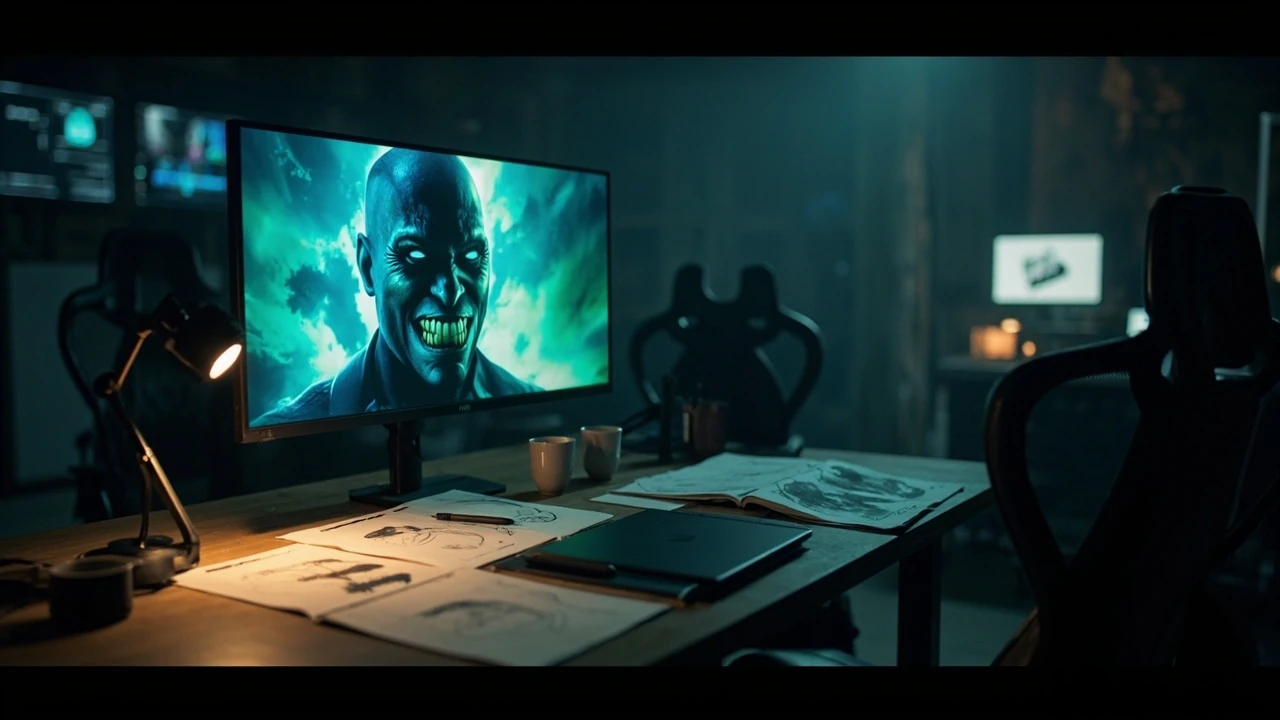
Absolute Joker in DC’s Absolute line: what game teams are actually adapting
A new version of a known villain changes more than the silhouette. When DC relaunched a major hero under the Absolute banner, the marketing and the early solicitations pointed to a different kind of antagonist: leaner, meaner, and built around body horror rather than the comic-book gags of the main universe. For a game studio, the absolute joker is the kind of IP-driven design problem that lives at the intersection of art direction, narrative tone, licensing, and technical planning. The question is not just “what does he look like” but “what does this version of the character demand from the production pipeline, the combat design, the audio direction, and the marketing beats that a publisher will sign off on.”
This page treats that problem as a working design brief. It assumes the reader is a developer, technical artist, or producer who has either received a brief referencing the Absolute line, or is preparing a pitch that has to coexist with it. We use the comic and the surrounding reporting as the public-facing source of truth and translate the implications into concrete production choices, the way a good pre-production doc would. We also stay inside what a writer, artist, or producer is actually allowed to say: confirmed by an interview, a solicitation, or a press image, and clearly labeled as reporting or interpretation when the line gets thin.
What the Absolute line is, and why the absolute joker reads differently
For a game team, the most useful question is: which parts of the character are stable across media, and which are license-controlled? The grin, the green, the purple, the word “Joker” – these are durable. The body-horror treatment, the specific backstory, and the visual references (clown, harlequin, surgical) are version-specific and may be negotiated line by line with the rights holder. Pitching a game adaptation without checking which of those elements are locked can burn weeks of art direction.
Reading the public reporting before you commit to a silhouette
The practical workflow is to build a small internal reference set before any art is generated. That set should include: the imprint-level visual rules, the per-character bible, any press imagery that has been released under a clear license, and a list of assets the publisher has explicitly forbidden (signature props, specific costume elements, named side characters). Until that set is complete, the right answer to “what does the absolute joker look like in our engine” is “we are still in the reference stage, and the silhouette below is exploratory.”
Why the absolute joker is a useful art-direction test for a studio
A high-profile villain is a useful stress test for an art pipeline because the character has to read at every scale: thumbnail, key art, in-game portrait, gameplay silhouette, and a one-second reaction shot in a trailer. If the design only works at marketing resolution, it is going to fail in a third-person combat camera. If it only works in close-up, the encounter design will feel like a cutscene in a costume. Studios that license IP characters tend to iterate on the silhouette first, then the color, then the face, then the animation personality, and only then move to costumes, props, and VFX passes.
The absolute joker, as reported, leans on body horror, which complicates each of those steps. Body horror reads best when anatomy, lighting, and skin shader work together, and it loses most of its impact when it is flattened into a cartoon grin. That is why the design review for a character like this usually adds a dedicated character TD and a look-dev artist early, rather than treating look development as a final pre-production pass.
Production roles a horror-leaning villain changes
Most licensed characters slot into an existing character pipeline. Body horror does not, because the line between “menacing” and “inadmissible on a console certification check” sits in a different place for every platform. That is one reason the absolute joker changes the staffing of a project. The roles that tend to be added or reweighted are listed below.
- Character technical director: owns the deformation rig, the corrective shapes, and the boundary between “anatomy that reads as human” and “anatomy that reads as wrong on purpose.”
- Look-development artist: locks the skin shader, the SSS profile, the sweat/oil response, and the color grading for the character’s lighting group before any animation is final.
- Narrative director: writes the scene-by-scene “what does this character earn from the player” map, including the reveal beats that match the cadence reported by trade press.
- Audio director: designs the vocal processing and ambient layers, because body horror relies as much on sound as on silhouette.
- Compliance producer: tracks platform-specific rules around horror content, since rating boards and store policies vary by region and by trigger.
None of these roles is new to a mid-size or larger studio, but the weight of the role shifts. A look-dev artist who normally spends two weeks on a hero character may need four to six weeks on a horror-leaning villain because the failure modes are quieter and easier to miss in a still frame.
Silhouette and color: a working starting point, not a final design
Public reporting on the absolute joker points toward a design that mixes the recognizable palette with a less theatrical silhouette. The honest working summary is that the character keeps the cultural anchors (green, purple, grin) and reframes the proportions. For a game team, that is a useful place to start because it lets the marketing team signal “this is a Joker” while leaving room for the look-dev team to push the anatomy in a darker direction.
The table below is a working reference for a pre-production review. It is not a description of the licensed design – we do not have the bible in front of us – and the rows are deliberately phrased as design questions rather than answers.
| Design axis | What a typical Joker iteration carries | What the Absolute framing implies | Game-pipeline consequence |
|---|---|---|---|
| Silhouette | Broad shoulders, long coat, theatrical hat | Leaner, closer to body, less prop weight | Capable of faster traversal and more readable dodge animations |
| Palette | High-saturation purple and green | Same anchors, desaturated, sometimes sickly | Look-dev must protect color contrast under cinematic grading |
| Face | Wide grin, white skin, red lips | More anatomical, less cosmetics-driven | Higher poly budget and a dedicated facial rig |
| Body language | Flamboyant, theatrical | Tense, predatory, less dance-like | Mocap session needs a movement coach, not just an actor |
| Iconography | Playing cards, joy buzzers, flowers | Recast as medical/surgical props | Prop list reworked; certification team briefed early |
Two sources do most of the heavy lifting for any external-facing summary. The first is the Absolute Batman Wikipedia entry, which tracks the imprint, the creative team, and the relationship between the main universe and the Absolute universe. The second is the AIPT feature on the villain’s evolution from horror hints to reveal, which captures the cadence of the rollout. Both are useful as anchors, but neither replaces a direct read of the licensed bible that a publisher will hand you the moment a deal is signed.
The table is a starting point. A real bible will lock some of these rows, free others, and add several that the public reporting does not touch. A studio should not commit budget against this table until the licensed reference set arrives.
Pipeline implications for a horror-leaning character
A body-horror villain is not “the same character with a darker skin shader.” It usually adds three concrete workstreams that a producer has to schedule and a director has to approve. They are not unique to the absolute joker, but the genre framing tends to surface all of them at once.
- Anatomy review sessions with the medical and anatomical references clearly cited, to keep the deformation work inside what the look-dev team is willing to defend in a dailies review.
- Shader and lighting tests in the actual gameplay environments, not in a neutral lighting rig, because the character has to survive a daylight level, a neon level, and a dark level without losing the reads.
- Audio tests at gameplay distance, not cinematic distance, because the menace of a horror character often collapses when the camera pulls back to a third-person combat shot.
If a producer tries to absorb those workstreams into a generic “character pass,” the most common failure is that the shader is signed off in the neutral rig, the lighting tests are deferred to the level art team, and the audio is approved in a stereo preview that nobody plays back in-game. The cost of those three deferrals is paid later, in the polish phase, when the only available response is a partial redo.
Animation personality and motion design
Animation personality is where a character like the absolute joker either lands or feels like a costume swap. The mainstream Joker reads as theatrical, and the motion design tends to be wide, slow, and slightly off-balance. The reported framing for the absolute joker is the opposite: tense, economical, and predatory. The mocap session is therefore a different kind of session. A typical brief is something like “no flourish, no break character, no theatrical gesture, but the moment the player loses line of sight, the body should telegraph where the character is going next.”
For a combat designer, that brief has a direct consequence: the villain’s tells have to come from the body, not from the costume or the prop. If the only readable signal of an incoming attack is the sound, the audio team will spend the rest of the project firefighting accessibility complaints. If the only signal is a UI flash, the animation team will spend the rest of the project firefighting complaints about “telegraphing.” The middle path is to make the body the primary tell and use audio and UI as reinforcement, and that is what a horror character usually needs.
Combat and encounter design considerations
A horror villain changes encounter design in two predictable ways. The first is the camera: the player needs to see the body language, so a third-person follow camera is more useful than an over-the-shoulder rig, and a first-person rig only works if the game commits to the body being visible in the world rather than the player’s hands. The second is the pacing: a horror character is most effective in short, repeatable encounters where the player is allowed to feel hunted, rather than in long arena fights where the player has the upper hand. A producer who has only worked on theatrical villains tends to over-budget the arena fights; a producer who has worked on horror tends to over-budget the stalking encounters. A balanced plan needs both.
The table below maps some of those choices to concrete engineering questions. It is not a recommendation for a specific game; it is a checklist of decisions that a horror-leaning villain forces onto a design doc.
| Decision | Default for a theatrical villain | Adjusted for a horror-leaning villain | Open questions for the team |
|---|---|---|---|
| Camera | Over-the-shoulder, with a wide combat camera | Third-person follow, with a tighter engagement distance | How much of the body must be visible at all times? |
| Encounter length | Long, with multiple phases | Short, with a stalking preamble | What does the player learn between encounters? |
| Stamina / health pool | High, with a phase break at 50% | Lower, with a regeneration mechanic that the player can interrupt | Does the regeneration telegraph or surprise? |
| Telegraph | Animation + audio + UI marker | Animation first, audio and UI as reinforcement | What is the accessibility floor for the most common tells? |
| Death / defeat state | Theatrical, often quipping | Quiet or anti-climactic, because horror loses momentum if it lingers | Is the death state a cutscene, an in-engine moment, or a camera cut? |
Two rows in that table are worth a closer look. The first is the accessibility floor: horror characters tend to rely on visual tells, which is a problem for players with low vision, color blindness, or photosensitivity. A team that is serious about platform compliance will design a fallback audio or haptic tell for every primary visual tell, and they will decide that in pre-production, not in certification. The second is the death state: horror villains lose their menace if the game lingers on the moment of victory, and a producer who has only worked on theatrical villains will be tempted to add a victory quip. The right answer is usually a faster cut, not a longer cutscene.
Audio direction for a body-horror antagonist
Audio is the half of the character that the marketing team tends to underestimate. For a body-horror villain, audio does three jobs at once. It establishes the presence of the character when the player cannot see the body. It carries the menace of the deformation in scenes where the camera is on the player’s face rather than the villain’s. And it sets the emotional floor of the encounter, which determines whether the player feels hunted or outmatched. A useful audio brief is something like “wet, close, slightly wrong, and never musical, even when the music wants to be.”
The Absolute line is DC’s imprint that relaunches core characters in an alternate setting, keeping the essential iconography but rebuilding the origin, the social context, and the visual language around it. Absolute Batman, the flagship title, sits inside that imprint. Reporting around the launch has consistently framed the title as a darker, more grounded read on Bruce Wayne’s world, and the antagonist is part of that reframe. The treatment of the absolute joker reported by AIPT’s coverage of the character’s evolution describes a long, deliberate tease from horror hints to a fuller reveal, which is a signal worth reading carefully if you are timing a marketing beat, a trailer, or a reveal trailer for an in-game event.
Implementation-wise, that brief translates into a small set of decisions. The first is the room tone: a horror character is most effective in a level with a low, steady room tone, because silence makes every footstep a tell. The second is the reverb profile: a closer, more intimate reverb on the voice, with a longer tail on the body movement, so the player hears the body before they hear the words. The third is the music policy: the score should be reserved, with the character providing most of the emotional signal, because a score that competes with a horror villain usually loses.
Narrative beats and the reveal cadence
The public reporting describes a deliberate tease for the absolute joker, moving from horror hints to a fuller reveal over the course of several issues and several marketing windows. For a game team, that cadence is more than a marketing footnote. It implies a few production decisions that a writer and a producer can lock in early.
- Backstory scenes are written first, but produced last, because the player only needs to see them after the reveal.
- Marketing-side reveals are scheduled against in-game reveals, so the trailer does not spoil the moment the player is meant to earn.
- The first playable appearance is a stalking encounter, not a boss fight, because the player has to learn the body language before they are asked to fight it.
- The voice performance is recorded with the reveal beat in mind, so the actor knows which line is the “this is who the character is” moment and treats it as a separate read.
That last point is worth a sentence on its own. A voice actor who has been performing in a horror register for several sessions can land the reveal beat in one take; a voice actor who has been performing in a theatrical register for several sessions will need a new read of the whole arc. The producer who books the sessions, not the actor, is the one who decides which scenario the project is in.
Compliance, certification, and platform rules
A horror character is one of the easier ways to fail a platform certification on the first pass, because the rules around horror content vary by region and by trigger, and they are not always the same rules that apply to violence. The cost of missing them is paid in the cert queue, which is one of the more expensive places to pay it. The practical move is to bring the compliance producer into the pre-production doc, not the cert submission, and to keep a running list of every scene that features the character in a non-combat context, because those scenes are usually where the cert issues live.
The list of common cert-relevant triggers for a horror villain is short but unforgiving. A studio that is still in pre-production can already make a list of scenes that are likely to be flagged and a per-region fallback. That list is not a guess; it is a decision log that the compliance team maintains alongside the art bible.
Marketing, trailers, and the question of “spoiler budget”
A villain who is rolled out through a horror-first cadence has a different marketing problem than a villain who is rolled out as a finished character. The marketing team has to decide, before the first trailer, how much of the body the public is allowed to see. Too little, and the player will not recognize the IP in the store page. Too much, and the in-game reveal is wasted. The trade-off is usually resolved by the store page and the key art, which use the silhouette and the color, and the trailer, which uses the body language in a single short shot.
The trailer is the most expensive marketing asset, and it is the one that is most often ruined by trying to please two audiences at once. A useful working rule is that the trailer is allowed to show the silhouette, the color, and one body-language beat, and that the rest of the reveal belongs to the player in-game. Studios that try to ship the whole reveal in the trailer usually have to re-cut it after the player community has already catalogued the moment in social media.
How the absolute joker fits into a wider game portfolio
For a studio that is pitching an original title alongside an existing licensed universe, the absolute joker is a useful character to think about because the design questions are the same questions the original characters will face. A studio that can answer “what is our look-dev process for a horror-leaning character” with a real schedule and a real team is in a stronger position to pitch a wide range of licensed and original work. The character is therefore as much a portfolio asset as it is a project asset, and the post-mortem on a successful adaptation is worth the same amount of internal documentation as the production itself.
That is also why the article leans on the production framing, rather than the marketing or the fan framing. The marketing framing belongs to the publisher and the licensor, and the fan framing belongs to the community. The production framing belongs to the studio, and it is the framing that a developer, an artist, or a producer can actually act on.
Working assumptions a team should write down before they start
A team that is about to take on a project like this will save itself time by writing a small set of assumptions down, in plain language, before the first concept is sketched. The list below is a starting point; each studio will have its own version.
- The licensed reference set has not yet arrived, and any concept art is exploratory until it does.
- The reveal cadence is owned by the publisher, and the studio’s role is to be ready for the first playable beat, not to drive the cadence.
- The character’s body language is the primary tell, and audio and UI are reinforcement.
- The character’s death state is a short cut or an in-engine moment, not a long cutscene.
- The compliance producer is part of the pre-production doc, not the cert submission.
None of these assumptions is final. They are the right starting point for a project that is about to take a horror-leaning, license-controlled, high-visibility character from a press cycle to a build.
Frequently asked questions
What is the absolute joker in the DC Absolute line?
The absolute joker is the version of the character that appears in DC’s Absolute imprint, alongside the relaunched Absolute Batman title. The public reporting frames the character as a darker, more horror-leaning antagonist than the main-universe version, with a reveal cadence that moves from horror hints to a fuller reveal across several issues. The licensed reference set that a studio would need for an adaptation is owned by the rights holder, and the public reporting is a useful anchor but not a substitute for that reference set.
How does the absolute joker differ from a main-universe Joker for a game team?
The main-universe Joker is usually designed around theatricality, with a wide silhouette, a bright palette, and a quippy personality. The absolute joker, as reported, is designed around body horror and a more predatory body language, which forces a different look-dev, animation, and audio pipeline. A studio that is adapting the absolute joker has to budget more time for the silhouette, the skin shader, and the mocap session than it would for a theatrical version of the character.
Which public sources should a developer read first?
The two anchors are the Absolute Batman Wikipedia entry, which tracks the imprint, the creative team, and the relationship to the main DC universe, and the AIPT feature on the absolute joker’s evolution from horror hints to reveal, which captures the cadence of the rollout. Neither source is a substitute for the licensed bible, and a studio that is pitching a project should treat both as orientation, not as the brief.
What production roles change when a villain is horror-leaning?
A horror-leaning villain reweights the character technical director, the look-development artist, the narrative director, the audio director, and the compliance producer. None of those roles is new to a mid-size or larger studio, but the time budget for each role usually grows, and the look-dev and audio roles in particular are paid in pre-production, not in polish.
How should a studio handle the reveal cadence in a game trailer?
The trailer should be allowed to show the silhouette, the color, and one body-language beat. The rest of the reveal belongs to the player in-game. A studio that ships the whole reveal in the trailer usually has to re-cut the trailer after the player community has catalogued the moment, and a studio that ships too little of the character in the store page will struggle to anchor the IP recognition in the storefront.
Why is body horror a problem for platform certification?
Body horror is one of the easier ways to fail a platform certification on the first pass, because the rules around horror content vary by region and by trigger, and they are not the same rules that apply to violence. The cost of missing them is paid in the cert queue, which is one of the more expensive places to pay it. The practical move is to bring the compliance producer into the pre-production doc and keep a running list of every non-combat scene that features the character.
What does “look-dev first” actually mean for a character like this?
“Look-dev first” means that the skin shader, the SSS profile, the sweat and oil response, and the lighting group are locked before any animation is final, and that they are tested in the actual gameplay environments, not in a neutral lighting rig. A horror-leaning character is unusually sensitive to lighting, because the body has to read in daylight, in neon, and in a dark level without losing the menace. A neutral rig will not tell the team whether the character survives a dark level; only the gameplay environment will.
How does the absolute joker fit into a wider game portfolio?
A studio that can answer the design questions raised by a character like the absolute joker with a real schedule and a real team is in a stronger position to pitch a wide range of licensed and original work. The character is therefore as much a portfolio asset as it is a project asset, and the post-mortem on a successful adaptation is worth the same internal documentation as the production itself. The most useful framing for a portfolio review is the production framing, not the marketing or the fan framing.
Leave a Reply