
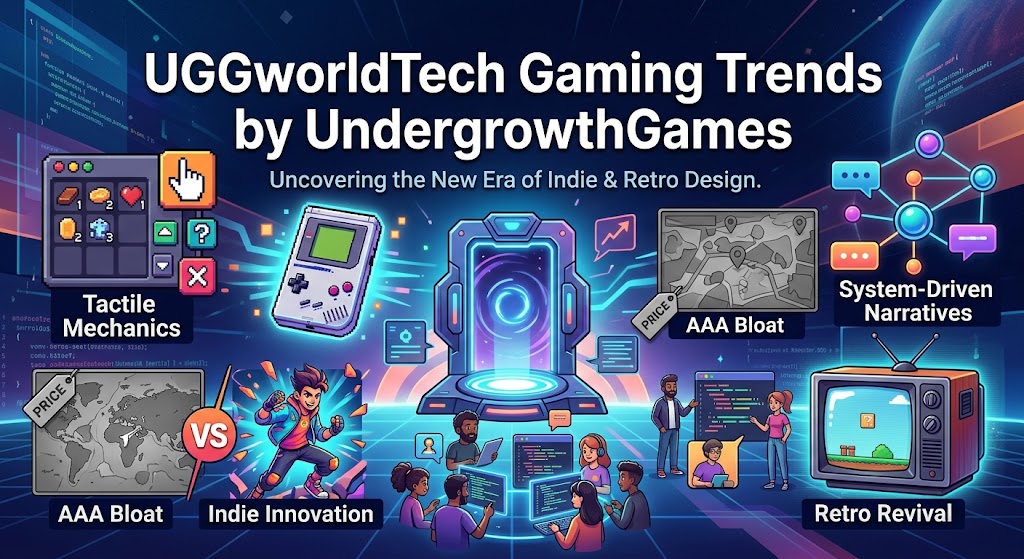
Uggworldtech gaming trends by undergrowthgames
Every few years, the gaming industry hits a point where everything feels a bit repetitive. Massive studios drop the same open-world titles, charge full price, and fill them with endless fetch quests. But if you look slightly under the surface, real innovation is happening right now. The uggworldtech gaming trends by undergrowthgames highlight exactly how independent design philosophies are quietly reshaping what we play every evening.
I was skimming through recent developer logs and forum breakdowns last weekend, and honestly, it hit me. We are moving away from hyper-polished, empty experiences toward systems that actually care about player agency. People are tired of holding down a button to watch a cinematic sequence. They want mechanics that react, break, and surprise them. Let us talk about what is actually changing on your screen today.
Think back to how games used to handle player choices. Usually, you got a dialogue wheel with three choices: good, bad, or sarcastic. Today, developers are tossing that out the window. Mechanics are becoming contextual. If you ignore an NPC, they remember it not because a script flagged it, but because the game world runs on active simulation states. That shift is huge, and it is changing how we interact with virtual spaces.
And look, it is not just about fancy code. It is about how these systems feel when you pick up a controller after a long day at work. You do not want a second job; you want an experience that respects your intelligence. That is precisely why tracking these grassroots movements gives us a way better picture of the future than any big trade show presentation ever could.
Uggworldtech Gaming Trends by Undergrowthgames and Indie Mechanics
When you analyze the uggworldtech gaming trends by undergrowthgames and indie mechanics, the first thing you notice is the return to tactile feedback. For years, AAA developers stripped away UI elements to make things look like movies. But guess what? Players actually like inventory management when it feels physical. Dragging items, packing backpacks, and managing physical grid space has become a mini-game everyone loves again.
Smaller studios realized they cannot compete with ten-thousand-person teams on raw graphic fidelity. So, what do they do instead? They double down on depth. They build physics engines that allow fire to spread based on wind direction, or systems where sound bounces off cave walls accurately. These micro-details matter way more to long-term replayability than ultra-high-definition character textures that eat up your hard drive space.
| Traditional AAA Design Focus | Emerging Underground Trend |
|---|---|
| Linear cinematic storytelling | Emergent system-driven narrative |
| Static environment interaction | Fully reactive physics models |
| Hand-holding map markers | Diegetic exploration and observation |
| Monetized progression loops | Skill-based intrinsic reward systems |
It is all about letting players break things a little bit. When a system allows for creative solutions-like stacking five wooden crates to skip an entire dungeon puzzle-it makes the player feel clever. That sensation is something scripted set-pieces can never replicate. Honest design focuses on tools rather than strict paths.
Another major shift is how difficulty is handled. Instead of just giving enemies ten times more health, newer indie projects alter AI behaviors. Enemies coordinate, retreat, use cover dynamically, and even panic when their leaders drop. This creates high-stakes moments without turning targets into tedious bullet sponges.
Uggworldtech Gaming Trends by Undergrowthgames for Retro Hardware
Another fascinating aspect of the uggworldtech gaming trends by undergrowthgames for retro hardware is the surprising revival of constraints. Why are developers in 2026 deliberately making games that look like they ran on hardware from thirty years ago? Because working within strict limitations forces incredible design creativity. When you cannot hide behind visual noise, your core gameplay loop has to be rock solid.
Low-poly aesthetics are no longer just a nostalgic gimmick; they are a deliberate artistic choice. They allow small teams to ship complete, polished experiences in months rather than decades. Plus, these titles run smoothly on almost anything, from high-end rigs to portable handhelds you toss in a backpack before catching a train.
- Low render distances reused creatively as atmospheric fog elements.
- CRT filter shaders mimicking authentic hardware phosphor glow effects.
- Physical media aesthetic choices integrated directly into save mechanisms.
There is also something deeply comforting about games that start instantly. You click play, and within three seconds, you are in control of your character. No unskippable publisher logos, no fifty-gigabyte day-one patches, and no mandatory account creation screens. Just pure, unadulterated interaction. That immediacy is something the modern industry lost along the way, but indie creators are aggressively bringing it back.
Hardware modding communities have naturally collided with this movement. We see custom handheld setups running bespoke engines built specifically to squeeze every drop of performance out of low-power chips. It proves that compelling design will always triumph over brute-force rendering power.
The beauty of this retro revival lies in its hybrid nature. Developers take the crisp controls, high framerates, and quality-of-life features of modern engines, then wrap them in retro visual styling. You get the aesthetic charm of 1998 with the silky-smooth responsiveness of today. It is truly the best of both worlds.
Consider how audio design has shifted here too. Instead of massive orchestral scores that drown out action, creators are returning to chiptunes, synthwave, and dynamic atmospheric audio. Sounds react directly to health levels or player speed, pulling you deeper into the environment without needing a single word of text on screen.
Naturally, this has created a culture where players talk to each other again. Without giant gold quest markers floating over NPCs’ heads, people go online to trade secrets, draw custom maps, and share discovery paths. It brings back that classic playground rumor vibe we all missed.
So, where does this leave the average player? In a great spot, honestly. You no longer have to drop thousands of dollars on graphics hardware upgrades every two years just to enjoy the best design ideas available right now.
Let us take a quick look at how engine choices shape these project outcomes across different development scale categories.
| Project Scope | Target Engine Choice | Primary Development Goal |
|---|---|---|
| Solo Retro Title | Godot / Custom C++ framework | Maximum performance & instant loading times |
| Mid-size Systems Game | Unity / Custom modular builds | Complex physics & interactive world logic |
| Experimental Narrative | Twine / Inky / Custom HTML | Branching paths & deep choice mechanics |
You can see how the technical foundation directly serves the design goal here. When toolsets become lighter and more accessible, developers spend less time wrestling with engine bloat and more time tweaking jump arcs, weapon weights, and enemy pathfinding logic.
Now, let us chat about community dynamics because no modern scene exists in a vacuum. The feedback loop between creators and early adopters has never been tighter. Devs post raw gameplay snippets on forums, gather feedback overnight, and push balance patches by the afternoon. It is rapid, messy, and incredibly authentic.
- Direct developer-to-player feedback channels bypassing marketing teams completely.
- Open alpha testing builds updated weekly based on player telemetry.
- Community-led localization efforts expanding accessibility across global regions.
This level of transparency builds real trust. When a game has a bug, players are way more forgiving because they know the human being behind the screen is actively working on it. There is no corporate speak, no PR fluff, just honest problem-solving between people who genuinely love the medium.
It also changes how games are funded and sustained. Instead of relying on predator-style battle passes or microtransactions, smaller teams rely on modest price tags and dedicated supporter bases. You buy the game, you own the content, and you play it at your own pace. What a novel concept, right?
- Modular quest systems allowing infinite player-generated custom scenarios.
- Opt-in visual filters catering to both modern displays and vintage monitors.
- Local co-op focus bringing couch gaming back into popular circulation.
When you combine all these elements, you realize we are witnessing a quiet revolution. The industry is splitting into two distinct paths: massive, risk-averse corporate blockbusters, and vibrant, highly experimental community project spaces. Most of the real excitement lives firmly in the second camp.
If you have been feeling burned out by modern releases lately, maybe it is time to look at what these smaller teams are cooking up. You might just find that spark that made you fall in love with gaming in the first place.
Before wrapping things up, let us address some common questions that pop up when discussing these underground shifts and modern indie trends.
Frequently Asked Questions
What Makes These Emerging Gaming Trends Different From Standard AAA Releases?
They focus on system depth, player freedom, and tactile mechanics instead of massive empty maps and flashy cinematic cutscenes.
Why Are Developers Moving Toward Retro Aesthetic Styles Nowadays?
Retro styles cut down asset production times, allowing small teams to focus entirely on deep mechanics and fluid performance.
How Do Modern Retro Games Handle Performance Optimization?
They leverage light custom engines that run smoothly on basic hardware, avoiding heavy visual bloat while keeping high framerates.
Are These Underground Trends Accessible For Casual Gamers?
Yes, because most titles prioritize intuitive gameplay, fast loading, and straight-to-the-point mechanics without complex menus.
Where Can Players Find These Experimental Indie Games?
Independent storefronts, community developer blogs, specialized gaming forums, and direct digital distributions host these projects.
Do These Titles Require High-End Computer Hardware Setups?
Not at all, as low system requirements mean you can enjoy them on budget PCs, older laptops, or modern handheld devices.
How Do Community Feedback Loops Shape Game Development?
Creators post raw builds online, get instant critique, and push updates quickly, creating games tailored directly to player desires.
Wrapping this all up, it is clear that the future of interactive entertainment is not just about raw computing power or bigger marketing budgets. It is about soul, smart design choices, and respecting the player’s time. The underground scene is proving that constraint breeds creativity every single day. Keep your eyes on these smaller projects-they are building the mechanics that everyone else will be copying five years from now.


Leave a Reply