Frozen Hearts Expedition 33: how the DLC’s collectible design is structured
The Frozen Hearts expansion for Expedition 33 is one of the most checklist-heavy pieces of content the studio has shipped, and understanding why is more useful to a GameDev reader than another copy of the item list. The region introduces parallel collectible families: expedition flags, bosses, weapons, pictos, tints, paint cages, expedition journals, haircuts, side quests, outfits, manor doors, and the rarer Perfect and Grandiose Chroma Catalysts. Each family behaves like a small system, with its own placement logic, reward loop, and failure case. A player chasing 100% completion is effectively running twelve mini-games at once, and a developer reading the same map can study how that density is achieved without breaking navigation or pacing.
This guide treats the DLC as a design artifact first and a player checklist second. It walks through the collectible families that the official completion page lists, explains how each one is typically integrated into a level, and flags the production decisions a small team would have to make to support a region of this size. Along the way it points out where the design leans on systemic placement, where it leans on authored scripting, and where a studio could reasonably copy the pattern in a smaller project.
Why Frozen Hearts is worth studying as a GameDev case study
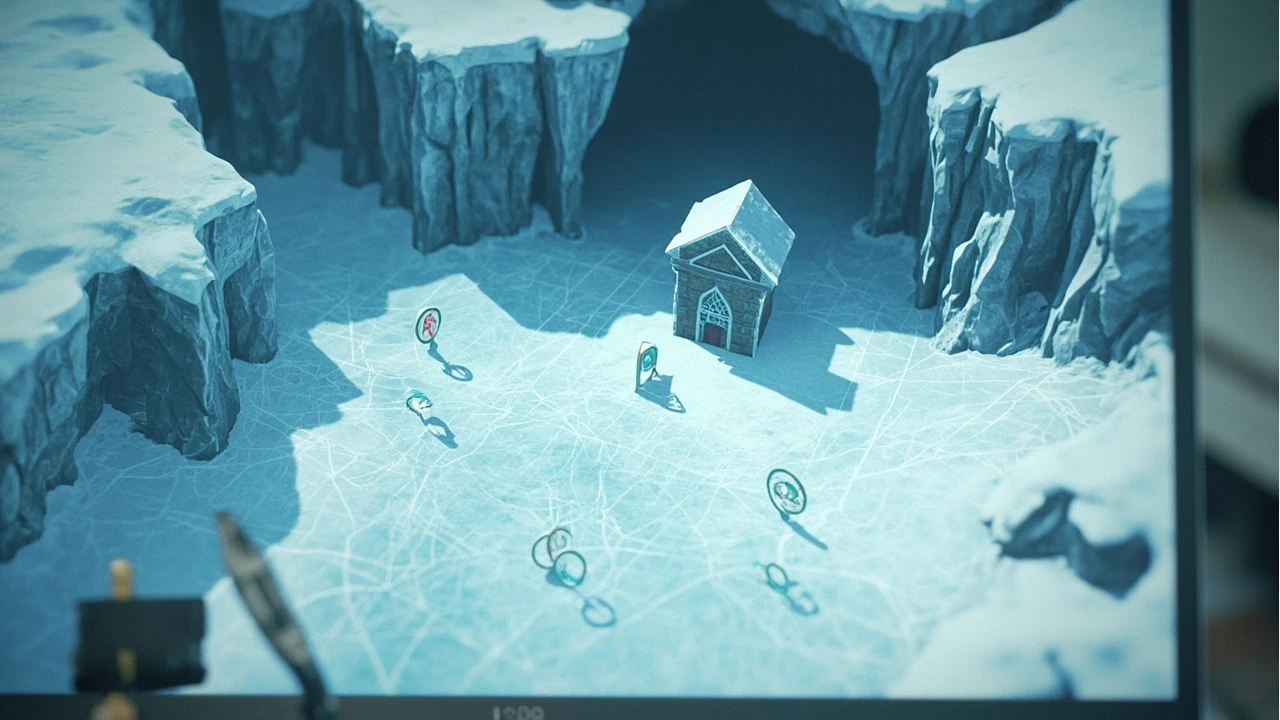
A region like Frozen Hearts looks straightforward from the outside: snow, ice, a frozen chapel, a few caves, and a long list of things to find. The interesting work is in the layering. A studio that ships twelve collectible families in one biome has solved several problems at once, including how to mark items without polluting the screen with icons, how to keep movement from feeling like a farming loop, how to gate rare items behind a small skill check, and how to let players self-organize their route.
For developers, the most useful question is not “how many collectibles are in the DLC” but “what systems are doing the work.” Most of the families listed on the Frozen Hearts 100% completion checklist rely on the same handful of building blocks: a trigger volume, a save flag, a UI notification, and a reward handle. Reading the checklist as a designer means reading those four hooks at scale, not just the items they unlock.
The twelve collectible families at a glance
Before looking at any single family, it helps to map the whole set. The table below summarizes the twelve collectible families exposed by the official Frozen Hearts checklist. The “design role” column is editorial interpretation, not a statement made by the source page; the source confirms only that each family exists and has a dedicated checklist elsewhere in the game.
| Family | Player experience | Likely design role | Implementation hint |
|---|---|---|---|
| Expedition flags | Visible waypoints placed across the map | Navigation scaffolding | Static or scripted placements with auto-save |
| Bosses | Combat encounters tied to the story or side content | Skill gating and pacing | Encounter volumes with reward bundles |
| Weapons | Combat tools that alter build options | Build diversity | Pickup with stat and socket data |
| Pictos | Equippable perks or modifiers | Build experimentation | Item with passive effect and stack rules |
| Tints | Cosmetic color shifts for outfits or weapons | Long-tail cosmetics | Simple unlock flag plus a UI color slot |
| Paint cages | Containers that require a tool or puzzle to open | Reward gating through interaction | Triggered mesh swap and inventory grant |
| Expedition journals | Lore entries scattered across the region | Worldbuilding density | Pickup with text asset and read state |
| Haircuts | Character customization options | Social and identity features | Vendor or pickup that writes a slot value |
| Side quests | Optional narrative threads | Content depth and retention | Quest graph with branches and rewards |
| Outfits | Wearable cosmetic sets | Visual progression | Inventory entry with mesh override |
| Manor doors | Specific interactable objects in the manor hub | Hub area storytelling | Doors with state, key, and unique dialogue |
| Perfect and Grandiose Chroma Catalysts | Rare crafting catalysts in two tiers | Endgame crafting sink | High-rarity drop or vendor exchange |
Most of these families are not new to Expedition 33. The DLC’s contribution is in how densely it packs them into a single region and how consistently it signals the presence of each one. That density is the real design lesson.
How the collectible families relate to each other
Looking at the list, three rough clusters emerge. The first cluster is navigation and orientation: expedition flags, journals, and manor doors. These exist to help the player move through space and understand it. The second cluster is combat and build: bosses, weapons, pictos, and chroma catalysts. These change what the player can do in fights. The third cluster is identity and cosmetics: tints, outfits, and haircuts. These change how the player looks while doing the other two clusters.
Side quests sit across all three clusters because a single quest can introduce a new weapon, point to a flag, and unlock a haircut. Paint cages sit between combat and identity because they often require a specific tool that the player only gets from a boss or a quest. A small team designing a similar region can copy this three-cluster pattern almost directly: a few navigation pickups, a few build pickups, a few cosmetic pickups, and one or two quest lines that bridge them.
Implementing expedition flags without cluttering the map
Expedition flags are the most visible family in Frozen Hearts. They are the items a player sees first when looking at the map, and they are also the family that is easiest to overdo. A flag on every ridge line turns the map into a polka-dot pattern and tells the player nothing about where to go next. The DLC’s likely answer is to use flags as confirmations of route progress rather than as raw markers: a flag is placed where the player is meant to pause, not at every point of interest.
For a developer, the technical implementation is usually a simple actor with three states: hidden, placed, and confirmed. The interesting decision is the rule that decides where a flag is allowed. A flag near a known save point is fine. Two flags within the same line of sight is usually a smell. A flag placed purely to fill a checklist is the start of a design problem that no UI icon can fix.
- Treat each flag as a waypoint, not as a wayfinding icon.
- Avoid clustering flags inside a single readable distance.
- Link each flag to a small visual change, such as light or cloth animation, so the world acknowledges the placement.
- Log flags to a single completion counter so the player can see progress without reading a checklist.
Designing boss encounters as collectibles
Bosses in Frozen Hearts function both as story beats and as collectible targets. A completionist player who only cares about the checklist still has to engage with the combat system, and a player who only cares about the story still gets a clear win condition when a boss falls. That dual role is what makes them useful as design objects.
The pattern that supports this dual role is to give each boss a small unlock list. The boss’s reward is rarely just an item; it is also a flag in a side quest, a paint cage key, or a chroma catalyst. The boss becomes a node that multiple collectible families depend on. For a small studio, the lesson is that bosses should be more than stat checks. The more systems a single boss touches, the more value the player gets out of fighting it, and the less the encounter feels like padding.
Weapons, pictos, and the build sandbox
Weapons and pictos together form the build layer of the DLC. Weapons change the base numbers and move sets, while pictos change the rules the player can stack. Placed in the world, they create a sandbox where the player can experiment with combinations as they explore. The completion checklist does not promise that any single combination is the right answer, and that is the point: the collectibles exist to let the player assemble their own build, not to push them toward a meta.
| Layer | Function in build | Player question it answers | Design risk if overused |
|---|---|---|---|
| Weapons | Base stats, animations, special abilities | How do I want to fight? | Balance churn when more weapons ship |
| Pictos | Passive modifiers, often stackable | What rules do I want to bend? | Combinatorial explosion that breaks balance |
| Chroma Catalysts | Rare crafting and upgrade materials | How far can I push one weapon? | Grind walls if drop rates are unclear |
For developers, the lesson is to keep the three layers independent in data, even when they connect in play. A weapon’s stats, a picto’s modifier, and a catalyst’s upgrade cost should be readable in isolation so that balance changes do not require touching every collectible’s placement in the level.
Paint cages, journals, and the value of small interactions
Paint cages and expedition journals look like small items, but they are doing a lot of work for the player. Paint cages turn exploration into a tactile act: the player has to find the right tool, often a brush or a key from a side quest, before the cage will open. Journals turn the act of reading into a reward in itself, which is a powerful design choice because it costs nothing on the simulation side and adds a lot to the world.
For a small team, both items are good candidates for systems that scale well with content. A paint cage is mostly a state machine: locked, openable, opened. A journal is mostly a data row: identifier, text, read state. The interesting decision is what unlocks each one, not the items themselves. Cages that require a unique key per cage become a chore. Cages that respond to a small set of tools encourage the player to revisit older content with newer tools, which is exactly the loop a completion checklist should support.
Outfits, tints, and haircuts as identity systems
Outfits, tints, and haircuts form the cosmetic layer. They do not change combat or navigation, but they change how the player feels about the time they have spent in the region. A completionist who walks out of Frozen Hearts with a new outfit, a new color, and a new haircut has a clear, visible sign of the work they have done. That visible sign matters more than the raw count of items collected.
From a production point of view, cosmetics are cheap to add once the base system supports them. A tint is usually a color value on an existing material. A haircut is usually a mesh swap on a known slot. An outfit is usually a set of swaps. The hard part is not the asset; it is the unlock data. The DLC’s checklist confirms that each of these families has its own unlock state, which means the studio treats identity unlocks as first-class content, not as a side effect of gameplay.
- Use one unlock flag per cosmetic family so a player can see progress at a glance.
- Keep cosmetic data separate from gameplay data so balance changes do not affect outfits.
- Make at least one cosmetic per family visible during normal play so the reward reads on screen.
Side quests as a bridge between families
Side quests are the most flexible family in the DLC because they can deliver any other family as a reward. A side quest can grant a weapon, open a paint cage, point to a flag, and end with a new haircut. The completion checklist lists side quests as their own line, which tells a developer something useful: the studio tracks side quest completion as a separate metric, not just as a sum of the items the quest hands out.
This separation is worth copying. If the studio instead counted only the items granted by a quest, then a player could “complete” the region by skipping dialogue and running to the reward. By tracking the quest itself, the studio keeps the narrative cost of the content visible in the save data. For a small project, the equivalent is to expose a simple boolean per quest and a count of completed quests on the map or save file.
Manor doors and the hub as a collectible space
Manor doors are interesting because they turn the hub area, which is normally a safe zone, into a collectible space of its own. A door is not just a path; it is a small puzzle, a piece of lore, and an unlock, all in one interactable. The design lesson is that the hub can carry content density too. Players do not have to leave the manor to make progress, which gives the DLC a second completion loop for players who are tired of the snow.
For developers, the technical pattern is usually a stateful actor with three values: locked, unlocked, and opened. The state changes are triggered by other systems: a side quest completes, a key is granted, or a stat threshold is reached. The door itself just reads the state and plays the correct animation. Keeping the door logic thin is what makes it cheap to add new doors later.
Chroma Catalysts and the endgame sink
Perfect and Grandiose Chroma Catalysts are the rarest items in the list, and they exist to give completionists a reason to keep playing after the obvious content is done. They are the kind of item that turns a checklist into a long-term project. The studio has split them into two tiers, which gives players a sense of progress even inside the rare tier: a player who has all the Perfect catalysts can still chase the Grandiose ones.
For a small studio, the lesson is that endgame sinks are easier to design when they are layered. A single rare currency with one use feels like a chore. Two rare currencies with related but different uses give the player choices and make the grind feel like a project. The DLC’s split between Perfect and Grandiose is a small example of that principle.
Production notes for a studio that wants to copy the pattern
A studio that wants to ship a region with a similar checklist can borrow a few rules of thumb from the Frozen Hearts layout. These are not rules in the strict sense; they are decisions that match what the checklist implies about how the content was built.
- Treat each collectible family as its own system with its own data table, even when several families share a trigger.
- Pick a small number of placement rules per family and reuse them, rather than scripting each item by hand.
- Expose completion counts per family so the player can see progress without consulting an external checklist.
- Use side quests and bosses as bridges between families so that one completion contributes to several metrics at once.
- Reserve a small tier of rare items for the endgame so the checklist does not feel finished after the first pass.
None of these choices are unique to Frozen Hearts, and that is the point. The DLC is a clean example of patterns that many studios already use, applied with enough density that the result reads as a new design.
Reading the DLC as a QA exercise
A region with twelve collectible families is also a region with a lot of ways to break. The completion checklist is, in part, a list of cases the QA team has to cover. Every flag has to be reachable. Every boss has to be defeatable with the intended build. Every paint cage has to open with the intended key. Every side quest has to grant its reward, and every cosmetic has to apply without crashing the outfit system.
For a small team, the practical lesson is to budget QA time per family, not per item. A studio that allocates an hour per collectible will spend too long on flags and not long enough on chroma catalysts. A studio that allocates an hour per family will catch the structural bugs that a per-item sweep misses, and that is where a checklist like this one usually breaks first.
What a developer can take into a new project
The strongest takeaway from Frozen Hearts is that a dense checklist is not the same as a dense level. The DLC ships a lot of items, but the level itself is a normal-sized snowy region. The density comes from how the items are layered, not from how big the map is. A small studio working on a comparable region can match the feel by committing to a few families and making sure each one is well placed, rather than by trying to ship all twelve at once.
The other lesson is that collectibles are a design surface. Each item is a small choice the player makes, and each family is a small system the player learns. The studio has used that surface to give the player a sense of ownership over the region: the flags are flags they placed, the weapons are weapons they chose, the journals are stories they read. A region that uses its collectibles that way is doing more with the same items than a region that just sprinkles pickups across a map.
Frequently asked questions
What is Frozen Hearts in Expedition 33?
Frozen Hearts is an Expedition 33 DLC region that adds a snowy biome and a large set of optional collectibles. The official completion checklist lists twelve families, including flags, bosses, weapons, pictos, journals, and chroma catalysts, each with its own tracking page elsewhere in the game.
How many collectible families does the DLC include?
The verified checklist page lists twelve families: expedition flags, bosses, weapons, pictos, tints, paint cages, expedition journals, haircuts, side quests, outfits, manor doors, and Perfect and Grandiose Chroma Catalysts. The studio tracks each family as its own completion metric, which is why a 100% run covers all of them separately.
Do players have to collect every family to finish the main story?
The source page describes the families as completion targets, not as story requirements. A player who only follows the main quest can finish the region without picking up every flag or reading every journal. The checklist is a completionist layer that sits on top of the main path, similar to how a completion guide for Stardew Valley cheats lists optional shortcuts that are not required to ship a farm.
Why does the DLC split chroma catalysts into two tiers?
The checklist lists Perfect and Grandiose Chroma Catalysts as separate items within the same family. From a design point of view, the split gives the endgame a second progression curve: a player can finish the Perfect tier and still have a clear goal in the Grandiose tier. It also lets the studio gate the rarest upgrades behind the rarest drops without locking the player out of the upgrade system entirely.
How are expedition flags different from regular map markers?
Expedition flags are placed by the player and act as waypoints, not as pre-authored map markers. The likely design role is to confirm route progress and give the player a way to plan a return trip through the snow. This is a different pattern from the callout systems used in tactical maps, where callouts are author-defined labels rather than player-placed markers.
Are side quests required to reach 100% completion?
Yes. The checklist lists side quests as their own line, and the studio tracks quest completion as a separate metric from the items the quests grant. A player who completes the items but skips the quests will not register as having finished that family, which keeps the narrative content visible in the save data.
How should a small studio plan content for a similar region?
A useful starting point is to pick a small number of families, perhaps three to five, and design placement rules for each one. The Frozen Hearts checklist is a useful reference because it shows how a studio can layer many families on top of a normal-sized level without making the map feel crowded. A team that wants to learn more about scope planning can also look at a general game outsourcing guide for how external partners can extend a small internal team during a content-heavy release.
What is the hardest family to design for in a checklist like this?
From a systems point of view, side quests and chroma catalysts tend to be the hardest because they connect to other families. A side quest can grant a weapon, open a paint cage, and point to a flag at the same time, which means a single bug can break three checklists at once. Chroma catalysts are hard because they sit at the rare end of the drop table, and players notice every missed drop.
Can a player use a guide to skip exploration in Frozen Hearts?
The official checklist page is structured as a reference, not as a step-by-step walkthrough. It lists each family and links out to a dedicated checklist for the whole game. A player can use it to plan a route, but the page itself does not promise that any particular item must be collected in a specific order. The studio keeps the order open so the player can run the region in the way that fits their build, similar to how a map guide for Bind in Valorant lists callouts without forcing a path.
Does the DLC change how the base game tracks collectibles?
The source page describes the Frozen Hearts checklist as a region-specific view that links back to whole-game checklists for each family. That structure suggests the base game’s save file is built to track every family across every region, with the DLC adding new entries rather than replacing the existing system. For a developer, that is a useful pattern: extend the existing data tables instead of forking them for a new region.




Leave a Reply