
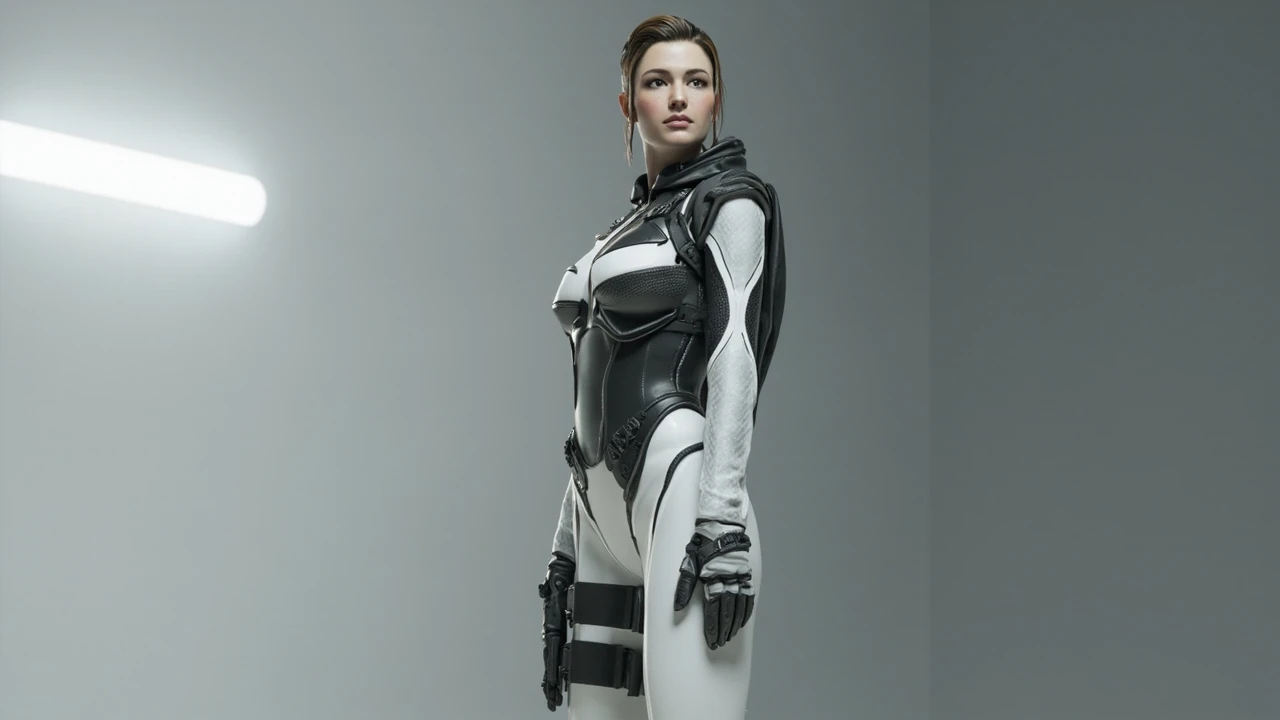
Stellar Blade outfits: what they are and how the system actually works
Stellar Blade outfits are the wearable costume sets that players equip on the protagonist Eve across the campaign. Each entry is a complete character model swap rather than a simple texture change, and most of them are built from a modular base mesh with replaceable upper-body, lower-body, and accessory layers. The wardrobe is more than a cosmetic layer because certain suits change Eve’s defensive values, alter her exposed skin response in combat, and unlock specific traversal or utility behaviors that designers chose to gate behind costume progression.
Players who treat the wardrobe as a pure vanity layer miss how the designers at Shift Up used clothing to communicate Eve’s narrative arc, her comfort level with the environment, and her mechanical readiness for harder encounters. Outfits also function as a pacing tool: high-stat suits are placed deep in side content, so a player who only follows the critical path will see fewer variants and lower stat ranges than a player who explores optional zones. Understanding that relationship is the first step toward making informed choices about which stellar blade outfits to chase, equip, or skip.
The wardrobe sits inside a larger action game built around a single shared animation skeleton, a fixed set of dodge and parry timings, and a small number of well-defined stat axes. That architecture is what allows the costume list to feel rich without diluting the combat feel. A new suit can change the numbers on the screen and the silhouette of the character, but it cannot rewrite the rhythm of a parry, and that constraint is the reason the system feels coherent across dozens of equip options.
The role of costume design in Stellar Blade’s combat and exploration
Costume design in Stellar Blade is tightly bound to combat readability. Enemy telegraphs reference the silhouette of Eve’s current suit, and certain enemy types react to the amount of visible skin through the suit’s damage state, which means a torn or damaged outfit is not just a visual flourish but a readable signal of how close a fight has pushed Eve to defeat. Designers also tie outfit choice to traversal: suits with integrated boots or reinforced plating can interact with specific environmental hazards differently than lighter suits, which is a deliberate signal that the wardrobe is part of the game’s systems layer rather than a separate menu.
From a production standpoint, the outfit pipeline is an interesting case study in how a single-player action game handles asset variants without breaking animation continuity. Each suit shares the same skeleton and the same set of attack, dodge, and traversal animations, which keeps combat consistent. The visible mesh is swapped, and the costume-specific VFX and audio cues are layered on top. This pattern lets the team ship a large wardrobe without rebuilding the combat system for every suit, and it is the reason a player can switch stellar blade outfits without losing muscle memory for parry timing or blade combos.
The same separation shows up in the way encounter designers plan enemy packs. Arena encounters are balanced around a set of assumed stat ranges, and those ranges are written with a small handful of suits in mind: a balanced mid-game suit, a high-defense option, and a high-mobility option. When a player equips an off-meta suit such as a cosmetic-only ceremonial outfit or a stealth variant that lowers melee damage, the encounter designer has to accept that the fight will play out a little differently than the scripted reference, and the game’s checkpoint and healing economy is built to absorb that variance.
Base outfit, starting suit, and the default look
Eve begins the campaign in a streamlined combat suit that the game uses as its visual baseline. The starting suit is balanced for the opening encounters, with moderate defensive values and no special utility behavior. It also serves as the reference silhouette for the game’s early enemy telegraphs, which is why some later suits feel like a noticeable change in pacing rather than a simple stat tweak.
The base outfit is not a free cosmetic: it is the suit the player must keep equipped through the prologue, and it cannot be unequipped until the wardrobe is unlocked. Once the wardrobe is open, players can return to the base outfit at any time, and many players keep it as a low-stat option for fights where they want to test their skill against a hard encounter without stat assistance.
The base suit also doubles as a teaching tool. Its stat profile is centered on the average value of every axis, so the player learns the feel of the game on a loadout that has no obvious weakness and no obvious strength. Later suits are introduced by contrast: the next suit the player unlocks usually changes one axis dramatically, which makes the mechanical difference between suits readable without a tutorial popup.
How outfits are unlocked in the campaign
Outfit unlocks in Stellar Blade are distributed across three main channels: story progression, vendor purchases, and exploration rewards. The exact unlock channels and prerequisites are worth understanding because they shape how a player experiences the wardrobe over a playthrough.
- Story progression: a small number of suits are granted automatically at fixed story beats, usually when Eve changes location or receives equipment from an ally.
- Vendor purchases: most suits are sold by in-world vendors in exchange for in-game currency, and the inventory rotates as the player advances the story.
- Exploration rewards: several suits are tied to optional containers, side missions, or hidden challenge rooms, which means they reward players who explore off the critical path.
The design intent behind this distribution is to keep the wardrobe from feeling like a single grind. Story suits provide a steady drip, vendors keep the economy active in mid-game, and exploration suits give completionist players a reason to backtrack through previously visited zones with new traversal tools. A player who wants to see the full list should plan to revisit at least two earlier zones after finishing the main story, because several exploration rewards are gated behind traversal abilities that are not available on the first pass.
Vendors are worth treating as a checklist rather than a one-stop shop. Most vendor inventories are split between a stable core of suits that are always available and a rotating selection that swaps in as the story advances. The rotation logic is tied to chapter flags, not real time, so a player who rushes the main story will see the same vendor offerings for a long stretch, while a player who mixes main story and side content will see the wardrobe refresh more often.
Stellar Blade outfits list and what each one does
The full wardrobe spans Eve’s journey from a guarded outsider to a more integrated ally, and each suit has a clear mechanical or narrative role. The table below summarizes the suits that are commonly referenced by players, the unlock channel, and the headline effect that the suit brings to gameplay. Specific names and stat ranges should always be cross-checked against the in-game wardrobe menu, because some suits have been adjusted in patches.
| Outfit | Primary unlock channel | Headline effect | Design intent |
|---|---|---|---|
| Standard combat suit (starting) | Story prologue | Baseline defense, no utility | Reference silhouette and tutorial-friendly values |
| Skin suit (mid-game default) | Story progression | Lower defense, higher mobility, more exposed skin | Signals Eve’s growing comfort in human spaces |
| Tactical field suit | Vendor purchase | Balanced defense, integrated utility pouch | General-purpose option for most encounters |
| Reinforced exo suit | Exploration reward | Highest defense, reduced dodge distance | Trade-off option for players who prefer blocking |
| Airborne suit | Side mission reward | Improved aerial control, lower ground defense | Rewards platforming-heavy play styles |
| Stealth suit | Vendor purchase after story chapter | Reduced enemy detection, lower melee damage | Designed around stealth sections and scouting |
| Allied unit uniform | Story progression | Balanced stats, unique dialogue reactions | Signals Eve’s affiliation with a faction |
| Ceremonial dress | Optional exploration reward | Cosmetic focus, no stat change | Reward for completionist exploration |
The table is a planning aid, not a substitute for the in-game wardrobe menu. Patch updates can change the exact stat values, and some suits have variants that are listed separately in the wardrobe. Players who want to optimize for a specific encounter should always confirm the current values in the equip screen before committing to a loadout.
One detail that often surprises new players is that the same suit name can appear twice in the wardrobe menu with different stat profiles. That usually means the second entry is a variant tied to a different vendor, a different edition of the game, or a later patch, and the equip screen will show the variant’s specific stat block. Reading the in-game description rather than the suit name is the only reliable way to tell the two apart at a glance.
Stats, defense, and how outfit choice changes combat
Outfit stats in Stellar Blade follow a small number of axes: defense, mobility, melee damage, and a small set of utility flags such as stealth, aerial handling, or hazard resistance. Defense determines how much damage Eve absorbs from unblocked hits, mobility determines dodge distance and recovery frames, and melee damage modifies the damage Eve deals with her equipped blade. The utility flags are usually binary, meaning a suit either has a given utility or it does not, and they tend to matter most in specific encounter types rather than across the whole campaign.
The interesting design question is how the developers chose to balance these axes. The reinforced exo suit is the most defensive option in the wardrobe, but its reduced dodge distance means a player who relies on the dodge-and-punish loop will feel slower, and the game punishes that choice with enemies whose attacks fill more of the screen. Conversely, the airborne suit improves aerial control, which sounds attractive, but its lower ground defense means a player who is hit while landing takes noticeably more damage. The wardrobe is therefore a series of trade-offs rather than a simple ladder, and the right choice depends on how the player has built their combat habits.
Stat values also interact with the upgrade system. Suit defense is added on top of any defense granted by Eve’s exoskeleton upgrades, which means a fully upgraded exoskeleton can mask the lower defense of a mobility-focused suit, and a fresh exoskeleton can leave a defensive suit feeling heavier than its stat block suggests. Players who want a clean read on whether a suit is the right pick should try it on a fresh save slot or before they have invested heavily in one upgrade path, so that the suit’s native stat profile is doing the work rather than the upgrade stack.
Encounter designers also use the wardrobe as a difficulty dial. Some late-game enemies have attack patterns that are designed to be readable at one specific stat profile, and stepping outside that profile with an off-meta suit can make the fight feel unfair even when the suit’s raw numbers are similar. This is most obvious in boss fights where the dodge window is tuned to the average mobility of a balanced mid-game suit; a heavy defensive suit will eat more hits but also miss the dodge timings the boss is built around, while a high-mobility suit will dodge the attacks but trade away the block stamina needed for the follow-up.
Cosmetic variants, colorways, and how they relate to the base suit
Each base suit in the wardrobe has a small number of cosmetic variants, usually delivered as alternate colorways or accessory packs. These variants share the base suit’s stat profile, which means the choice between two variants of the same suit is purely visual. The production reason is straightforward: variants are the cheapest way to expand a wardrobe without adding new animations, and they let the developers reward players who want a particular look without inflating the combat design space.
Variants are typically unlocked through the same channels as their parent suit, though some are exclusive to specific editions of the game or to limited-time promotions. Players who care about a particular look should check the wardrobe menu for variant availability before assuming a base suit is the only option in its line.
From a collection standpoint, variants are how the wardrobe reaches the double-digit count that the wardrobe menu advertises. A base game with eight parent suits and two variants per suit produces a wardrobe of more than twenty entries without adding a single new animation. The menu presents each variant as a separate row because players want to see and select it as a distinct option, but the combat system treats the variant as identical to the parent.
There is one edge case worth noting. A small number of variants are tied to promotional events that have since closed, and those variants will not appear in the wardrobe menu for players who did not redeem them during the active window. The game does not retroactively grant these variants, and there is no in-game vendor that sells them, so a player who wants a specific promotional variant has to confirm whether the promotion is still active before assuming the variant is available.
Outfits, damage state, and the visual language of a fight
One of the more distinctive decisions in Stellar Blade’s costume design is the way outfits respond to damage. As Eve takes hits, the suit’s mesh shows progressive wear, and in some cases the damage state exposes more of the underlying character model. This is a deliberate readability choice: it gives the player a peripheral signal of how close they are to a fatal hit without forcing them to read a numeric health bar in the heat of combat.
From a production standpoint, this kind of layered damage response is technically demanding, because the mesh has to deform and re-texture in real time without breaking the animation system. The team handles it by using a damage-driven material parameter rather than a full mesh swap, which keeps the animation budget stable across suits. The interesting result is that stellar blade outfits carry narrative weight as well as mechanical weight: a heavily damaged suit tells a story about the fight that just happened, even before the player checks the health bar.
Damage states also give the player a way to learn enemy behavior. A fight against a fast, low-damage enemy will barely mark the suit, while a fight against a slow, high-damage enemy will leave the suit visibly torn within a few hits. After a few encounters, a player can glance at the suit’s damage state at the start of a fight and read the threat level before the first attack lands, which is the kind of readability that action games tend to build through UI but Stellar Blade builds through costume design instead.
How outfits interact with traversal and the open zones
Stellar Blade’s open zones include sections that reward specific traversal behaviors: long jumps, climbing sequences, and stealth approaches. Several outfits in the wardrobe are designed to make these sections easier. The airborne suit, for example, gives the player more control during glide sequences, while the stealth suit reduces the detection radius of patrolling enemies, which is useful in zones where the player wants to avoid a fight entirely.
These traversal interactions are the reason a one-size-fits-all loadout is rarely optimal. A player who is about to enter a platforming-heavy zone may want to swap to a suit that improves aerial handling, even if it means lower defense against the enemies at the end of the platforming sequence. A player who is about to enter a dense combat arena may want the reinforced exo suit, even if it makes the preceding traversal section slower. The wardrobe is therefore part of the player’s tactical vocabulary, not just a collection of skins.
Traversal utility is also where the wardrobe overlaps with the upgrade system. Several traversal upgrades are gated behind zones that require specific suits to reach, which means the player’s progression path through the open zones is shaped by which suits they have already unlocked. A player who is missing the airborne suit when they reach a high-altitude platforming section will often be forced to backtrack once the suit is unlocked, and that backtracking is the intended pacing rather than a bug.
Outfits as narrative markers
The For additional context, narrative role of stellar blade outfits is more interesting than the wardrobe menu suggests. Eve’s relationship to the human settlements she visits is reflected in the suits the game makes available to her. Early suits are functional and guarded, mid-game suits signal her growing comfort in human spaces, and late-game suits mark her as a trusted ally or a recognized figure in the world. Players who change suits often will notice that certain NPCs react differently to Eve depending on what she is wearing, which is a small but effective way of using the wardrobe to do narrative work that would otherwise require cutscenes.
For a player who is interested in the story, the wardrobe is therefore a useful lens on Eve’s arc. A careful playthrough that changes suits at each major story beat will read the narrative through the costume changes, while a player who ignores the wardrobe will get the same story beats through dialogue but miss the visual through-line.
There is also a quieter narrative layer in the suit descriptions. Each suit’s in-game blurb mentions the context in which Eve acquired it: a gift from a faction ally, a salvage find in a derelict zone, a uniform issued by a settlement that has accepted her. Reading those blurbs in order is a low-cost way to map Eve’s integration into the world, and it is the kind of detail that the wardrobe menu exposes without forcing the player to track it through the main quest log.
Production notes: how a wardrobe of this size is built
Building a wardrobe of this size in a single-player action game is a meaningful production effort. The team has to author a complete character model for each suit, a complete set of damage states for each suit, a set of VFX and audio cues for each suit, and a wardrobe menu that can present all of this to the player without overwhelming them. The animation system, by contrast, is shared across suits, which is the key decision that makes the wardrobe feasible at the shipped scope.
For studios that are studying stellar blade outfits as a production case, the most useful takeaway is the discipline of separating mesh, animation, and stat layers. The team shipped a large wardrobe by keeping the animation layer constant, varying the mesh and material layers per suit, and using a small number of well-defined stat axes to express the mechanical differences. That separation is what allows the wardrobe to feel rich without ballooning the production schedule, and it is the pattern that other action games with large cosmetic catalogs tend to follow.
QA is the other side of the same problem. Every new suit has to be tested against the full encounter list to confirm that the stat profile is consistent with the encounter designer’s intent, and every cosmetic variant has to be tested against the animation system to confirm that the mesh swap does not introduce clipping or shadow artifacts. Stellar Blade’s QA cycle is longer than a game without a large wardrobe would require, and that cost is part of why most action games keep their wardrobes smaller or push new suits into a post-launch roadmap rather than the day-one ship.
Audio is the layer that is easiest to overlook. Each suit has a small set of movement and impact sounds that have to be tuned to the mesh’s material and weight, and a heavy suit cannot share the footstep sound bank with a light suit without breaking the player’s sense of mass. The audio team for a wardrobe of this size has to author and test a sound set per suit, which is a non-trivial line item on the schedule and another reason the animation layer is held constant: it gives the audio team a stable set of motion events to attach sounds to.
Common questions about the wardrobe
Players who are new to the wardrobe often ask the same handful of questions. The answers below are written to be useful at a glance, and they are framed in terms of decisions the player can actually make in the equip screen.
- Can I switch outfits during combat? No, outfit changes are made from a rest point or the wardrobe menu, not in real time during a fight.
- Do outfits affect parry timing? No, parry timing is governed by Eve’s animation, which is shared across suits.
- Is there a “best” outfit? No single outfit is best for every encounter; the right choice depends on the encounter type and the player’s habits.
- Do vendors restock? Vendor inventories rotate as the story advances, so a suit that is not available early may appear later.
- Do outfits carry over to a new playthrough? Most suits do, but it depends on the player’s save and the game’s carry-over rules.
These answers are the most common decisions a player faces in the wardrobe, and they are a useful checklist before committing to a particular loadout for a difficult encounter.
It is also worth noting that the wardrobe menu is the only place where the suit names are guaranteed to be consistent with the current patch. Online databases and walkthroughs can drift out of date as the game receives balance updates, so the in-game menu is the reference the rest of this article is written against. If a stat value in the menu disagrees with a value quoted in a guide, the menu is the source the player should plan around.
How to choose the right outfit for a given fight
Choosing the right outfit is a small decision that can change the feel of a fight. A useful mental model is to start with the encounter type, then narrow down to the suit that matches the player’s habit.
- Identify the encounter type: dense melee arena, platforming-heavy zone, or stealth approach.
- Pick the suit that best supports that encounter type based on the stat axes above.
- Confirm the suit’s variant if the player cares about the visual look, since variants share the parent’s stats.
- Check the in-game wardrobe menu for the latest stat values, since patches can adjust balance.
- Switch back to a balanced suit for general exploration, since specialization is rarely the right choice outside specific encounter types.
This sequence keeps the wardrobe from becoming a guess and turns it into a deliberate choice that supports the player’s preferred play style. For players who want a broader read on how the game’s combat and wardrobe system lands in actual play, the 4Players review of Stellar Blade walks through how the costume system holds up across a full playthrough and where it leans on the player’s habits rather than the stat block.
Limitations and what the wardrobe does not do
It is worth being clear about what stellar blade outfits do not do, because the wardrobe is sometimes described in ways that overstate its scope. Outfits do not change the player’s parry or dodge windows, because those are governed by the shared animation layer. Outfits do not grant new blade moves or new combos, because blade moves are tied to the equipped weapon rather than the suit. Outfits do not change the story, because the campaign’s beats are fixed regardless of what the player is wearing, even if certain NPCs react differently to specific suits.
These limits are not flaws; they are the result of a deliberate design decision to keep the wardrobe mechanically narrow so that the rest of the combat system can remain consistent. A player who is choosing between suits should make that choice on the axes the wardrobe actually controls, not on axes it does not.
One related limit is the lack of layered equipment. Stellar Blade does not let the player mix a chest piece from one suit with the legs of another, and there is no transmog system that lets a player keep the stats of one suit while displaying the look of another. Each entry in the wardrobe is a complete costume, and the player has to choose the look and the stat profile together. That constraint is a deliberate simplification, and it is part of why the wardrobe menu can be presented as a clean grid rather than a layered equipment screen.
Working title draft
For readers who want a short reference of the suits covered in this article, the table below restates the headline effects in a compact form that is easy to scan during a playthrough.
| Suit line | Best for | Watch out for |
|---|---|---|
| Standard combat suit | Learning the basics | Limited late-game utility |
| Skin suit | Aggressive dodge play | Lower defense in long fights |
| Tactical field suit | General purpose | No standout specialty |
| Reinforced exo suit | Boss fights and dense arenas | Reduced dodge distance |
| Airborne suit | Platforming and aerial combat | Lower ground defense |
| Stealth suit | Stealth sections and scouting | Lower melee damage |
| Allied unit uniform | Story-heavy sections | Limited mechanical edge |
| Ceremonial dress | Cosmetic and role-play | No stat change |
This compact view is a useful complement to the longer table earlier in the article, and it gives the player a quick reference when they are about to swap suits at a rest point.
Frequently asked questions
How many stellar blade outfits are there in the base game?
The base game ships with a wardrobe of several complete suits, each with a small number of cosmetic variants. The exact count has shifted across patches, so the most reliable number is the one shown in the in-game wardrobe menu at the time the player is playing.
Do stellar blade outfits change Eve’s stats?
Yes, most suits modify Eve’s defensive values, mobility, melee damage, and a small set of utility flags such as stealth or aerial handling. Cosmetic variants of a base suit share the parent suit’s stat profile, so the choice between variants is visual rather than mechanical.
Can I switch outfits at any time?
Outfits can be switched from the wardrobe menu, which is accessible at rest points and at specific safe zones. Outfits cannot be switched during a live combat encounter, so the player should plan loadout changes before a fight begins.
Are any outfits missable?
Some exploration rewards are tied to optional zones, which means a player who skips optional content may miss specific suits or variants. Most suits remain available through vendors or later story progression, but a small number of exploration rewards do not return once their zone is left behind.
Do outfits affect the ending of the game?
No, the campaign’s story beats and ending conditions are fixed regardless of what the player is wearing. Some NPCs react differently to specific suits, but the wardrobe does not gate story outcomes.
Is the skin suit the best outfit for damage?
The skin suit is not a pure damage option; it is a mobility option that trades defense for dodge distance and recovery. A player who wants higher damage should consider the weapon loadout rather than the suit, because blade damage scales with the equipped weapon.
Do outfits work in new game plus?
Most suits carry over to a new playthrough, but the exact carry-over rules depend on the player’s save and the game’s progression rules. Players who want to start a new playthrough with a specific loadout should confirm the carry-over list before starting.
What is the most defensive outfit in the wardrobe?
The reinforced exo suit is the most defensive option in the base wardrobe, with the trade-off of reduced dodge distance. Players who prefer a blocking-heavy play style will get the most out of this suit, while players who rely on the dodge-and-punish loop will find it slower than the alternatives.
Are stellar blade outfits used in mods or community content?
Mod support for Stellar Blade is limited compared to PC-first action games, and the wardrobe is primarily experienced through the in-game system. Players who are interested in modding patterns more broadly can use the wardrobe as a reference for how a single-player game structures cosmetic variants without a live service pipeline.
Do vendors rotate their outfit inventory?
Yes, vendor inventories rotate as the story advances, which means a suit that is not available early in the game may appear later. Players who want a specific suit should check back with vendors after each major story beat rather than assuming the early-game inventory is the full list.



Leave a Reply