Game Development Services for Modern Interactive Experiences
Making a great video game takes a lot of effort. You need a solid vision, technical skills, and a team that understands how to bring interactive worlds to life.
That is where professional game development services come into play. Whether you are an indie creator with a unique concept or an established studio looking to scale production, working with experienced developers makes a massive difference.
The gaming industry moves fast. Technology changes every year, and player expectations keep rising. So, having the right technical foundation is essential if you want your project to stand out.
Let us look at how modern studios turn ideas into playable realities, what processes they follow, and how you can choose the right path for your upcoming title.
Why Custom Game Development Services Matter Today
Building a game from scratch requires a blend of creative artistry and complex engineering. It is rarely a straightforward path.
Many teams start with big ideas, but they hit technical roadblocks during implementation. Code performance drops, assets become too heavy, or multiplatform builds break down.
By leveraging dedicated game development services, you gain immediate access to battle-tested workflows, qualified programmers, artists, and sound engineers. You do not have to spend months recruiting full-time staff for short-term needs.
Instead, you can focus on core mechanics, world design, and community engagement while technical specialists handle backend architecture, optimization, and platform compliance.
And that speed to market can easily determine whether a game hits its strategic release window or gets left behind in a crowded store.
Core Benefits of Outsourcing Game Development Services
Outsourcing parts of your project-or even full-cycle production-offers distinct advantages that can save both time and budget.
First, it grants instant access to specialized expertise. Need a physics developer who knows how to optimize vehicles in Unreal Engine? Or maybe a UI/UX designer focused strictly on mobile RPGs? Finding those individuals locally can take months.
Second, it offers financial flexibility. You can scale your team up during heavy asset production phases and scale back down when moving into QA testing and post-launch maintenance.
- Access to specialized technical roles without long-term hiring overhead
- Faster prototyping phases to validate core gameplay loops early
- Cross-platform deployment capabilities covering mobile, PC, and console
- Established quality assurance workflows that catch bugs before certification
- Post-launch support options for continuous updates and live-ops maintenance
Here is how different studio models structure their production teams based on project requirements: Full-Cycle OutsourcingStartups, publishers, non-gaming brandsTurnkey solution from concept to launch12 to 36 monthsCo-DevelopmentEstablished mid-tier and AAA studiosScales existing internal engineering teams6 to 24 monthsSpecialized Asset ProductionTeams needing 3D art, audio, or UIHigh visual quality without internal art leads1 to 6 monthsPorting & OptimizationGames expanding to new platformsReaches wider audiences quickly3 to 9 months
| Studio Model | Best Suited For | Primary Advantage | Typical Timeline |
|---|
Choosing the right engagement model depends heavily on your existing team structure and internal technical capabilities.
The Full-Cycle Game Production Pipeline Explained
Every successful game follows a structured lifecycle. While creative iteration is always flexible, having a clear roadmap prevents costly scope creep.
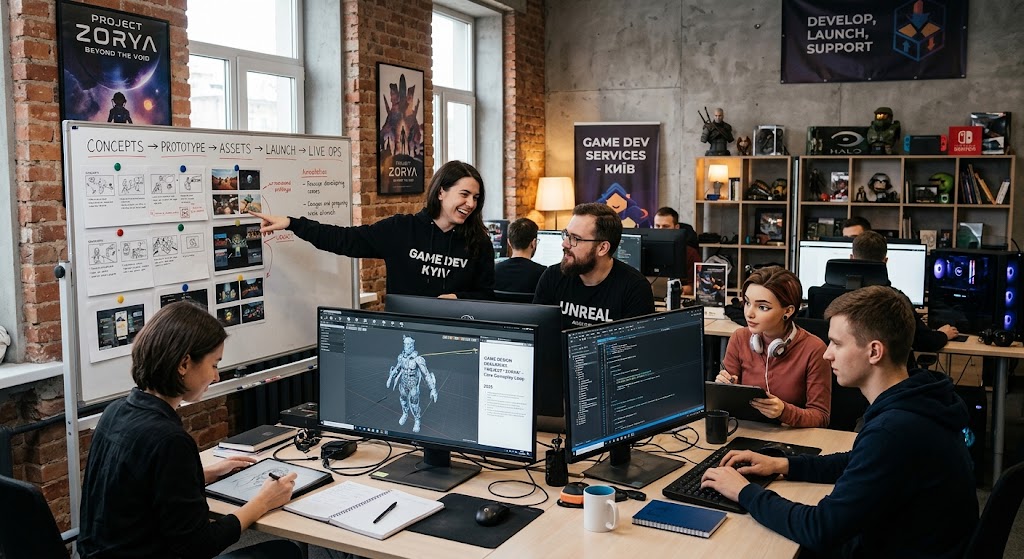
The process usually breaks down into pre-production, active production, and post-launch support. Each stage targets specific milestones to ensure the project stays on track.
So, what actually happens during these phases?
Pre-Production: Laying the Foundation
Pre-production is all about answers. What is the game core loop? Who is the target audience? What technology stack fits best?
During this stage, designers draft the Game Design Document (GDD), engineers build rapid prototypes, and concept artists establish the visual tone.
Skipping this phase usually leads to massive headaches later. Testing ideas on paper and in quick, blocky prototypes saves hundreds of hours of coding down the line.
Production: Building the Experience
Once the concept is validated, full production begins. Artists sculpt high-poly models, convert them to game-ready assets, and apply textures. Programmers write mechanics, AI behavior, network code, and user interface systems.
Sound designers compose music, record voice lines, and craft environmental audio. Level designers stitch everything together into cohesive gameplay environments.
This phase demands constant communication, regular builds, and rigorous version control to avoid technical friction.
Post-Production and Live Operations
After certification and release, the work is not over. Modern games rely on continuous engagement through patches, seasonal content, and community updates.
- Concept Art & Storyboarding: Visualizing characters, environments, and color palettes
- Prototyping & Greyboxing: Validating player movement, camera controls, and combat systems
- Asset Creation & Rigging: 3D modeling, texturing, animation, and lighting setups
- Software Engineering: Implementing gameplay mechanics, networking, UI, and database connections
- Quality Assurance: Rigorous functional, compliance, and performance testing across hardware setup
Key Technical Stacks and Game Engines
Selecting the right engine sets the boundaries for what your project can achieve technically and visually.
Most commercial projects rely on established engines like Unity or Unreal Engine, though custom engines remain popular for specialized proprietary needs.
Unity excels in cross-platform deployment, mobile optimization, and rapid 2D/3D development. It features an extensive ecosystem and flexible C# scripting.
Unreal Engine leads the industry in high-end fidelity, real-time lighting, and cinematic visuals. It utilizes C++ and Blueprint visual scripting, making it ideal for high-budget PC and console releases. UnityCross-platform flexibility, huge plugin ecosystemMobile, PC, Console, Web, VR/ARCasual, RPG, Simulation, Mobile StrategyUnreal EnginePhotorealistic graphics, Nanite, Lumen systemsPC, PlayStation 5, Xbox Series X/SFPS, Action-Adventure, Open World, AAAGodotLightweight, open-source, fast iterationPC, Mobile, Web2D Platformers, Indie 3D titlesCustom C++ EnginesMaximum performance control, tailored architectureConsole, PCProprietary franchises, massive multiplayer
| Engine / Technology | Primary Strengths | Target Platforms | Ideal Game Genres |
|---|
Look at your target platforms and visual goals before committing to a technology stack. Changing engines mid-development is exceptionally expensive.
Selecting the Best Game Development Services for Your Needs
Not all development partners are created equal. Some excel at stylized mobile games, while others specialize in photorealistic PC shooters or web-based multiplayer platforms.
When searching for game development services, evaluate their portfolio thoroughly. Look beyond pretty screenshots-play their published titles to judge performance, frame rates, and polish.
Communication is another key factor. Ensure the agency uses modern project management tools like Jira, Trello, or Slack, and maintains regular milestone reviews.
- Review published portfolio titles on actual target hardware to evaluate real performance
- Verify client references and past project case studies in your specific genre
- Evaluate their code architecture standards and IP transfer agreements
- Ensure transparent communication channels and regular sprint reviews
- Confirm clear post-launch bug fixing and support SLA commitments
Here is why it matters: transparent production pipelines keep projects on budget and prevent unexpected delay cycles near release dates.
Now, let us address some common questions creators ask when evaluating technical production options.
Frequently Asked Questions
What Are Game Development Services?
Game development services encompass specialized professional solutions provided by external studios or agencies to help creators build, launch, and maintain video games. These offerings range from full-cycle game creation to specific tasks like 3D modeling, programming, UI design, QA testing, and console porting.
How Much Does It Cost to Hire Game Development Services?
The cost varies significantly depending on game complexity, platform target, visual fidelity, and project scope. Simple 2D mobile titles can range from $15,000 to $50,000, while complex 3D multiplayer PC or console titles often range from $100,000 to several million dollars. Working with an agency allows tailored budgeting based on milestone deliverables.
How Long Does Full Game Development Take?
Development timelines depend directly on scope and team size. A small mobile or casual game might take 3 to 6 months. Mid-tier indie titles typically take 12 to 24 months, while large-scale PC or console titles can require 3 to 5 years of active production.
What Is the Difference Between Unity and Unreal Engine?
Unity is widely known for its versatility across mobile, 2D, 3D, and VR projects, offering fast iteration times and easy C# scripting. Unreal Engine offers industry-leading visual fidelity, advanced lighting features, and high C++ performance, making it the top choice for photorealistic 3D titles and high-end console releases.
Can an Outsourcing Partner Build My Game From a Simple Idea?
Yes. Full-cycle development teams can take an initial concept and guide it through conceptualization, game design documentation, prototyping, art creation, coding, testing, and eventual store publishing on platforms like Steam, Apple App Store, Google Play, PlayStation, or Xbox.
Who Owns the Intellectual Property When Using Development Services?
Under standard commercial contracts, you retain 100% of the Intellectual Property (IP), code, art assets, and design documents created for your project. Always verify that your service contract explicitly includes a full assignment of IP rights upon payment completion.
How Do Teams Ensure Quality Control During Game Production?
Studios maintain quality through structured agile sprints, automated build testing, device performance profiling, continuous integration pipelines, and dedicated Quality Assurance (QA) teams that run functional, regression, compliance, and playability tests throughout development.
Bringing a video game concept to life is a challenging yet highly rewarding process. By choosing the right game development services partner, you combine your creative vision with technical execution, setting your project up for real market success. Plan carefully, prioritize solid mechanics, and build with scalability in mind.


Leave a Reply